
Pakistan’s defense and aerospace sector has traditionally stayed far from public view. Most projects moved through government institutions, military-linked organizations, or tightly controlled contractors. Startups rarely entered the picture. That situation is beginning to change. A small group of founders is now trying to build companies around drones, artificial intelligence, robotics, mapping systems, and aerospace software. Some focus on agriculture and logistics. Others work on surveillance, rescue systems, or autonomous flight technology. A few have even managed to attract foreign investment despite the regulatory barriers surrounding the sector. Still, operating in this space is not simple. Regulations remain strict. Testing permissions takes time. Import restrictions, certification issues, and limited funding create constant pressure for local startups trying to survive long enough to scale. The question now is no longer whether Pakistan has technical talent. The bigger question is whether the ecosystem can support companies working in one of the country’s most sensitive industries.
Pakistan’s Defense Manufacturing System
Pakistan already has a long-established defense manufacturing structure. Most of it operates through state-backed organizations. One of the largest names is Global Industrial & Defence Solutions (GIDS), a Rawalpindi-based organization formed in 2007. The company develops unmanned aerial vehicles, surveillance systems, and other military technologies. Over the years, GIDS has introduced several drone platforms, including the Shahpar series. In 2024, it unveiled the Shahpar-III, a high-altitude drone designed for long-range operations. According to publicly available details, the drone can fly at around 35,000 feet and carry a large weapons payload. Large organizations like GIDS operate at a completely different scale compared to startups. They have direct institutional backing, established supply chains, and access to testing infrastructure that smaller companies usually cannot afford. That gap creates both a challenge and an opportunity for newer companies entering the sector.
The Rise of Private Drone Companies
Unlike traditional state-run organizations, some private firms have managed to build drone manufacturing businesses in Pakistan over the last two decades. One example is Integrated Dynamics, based in Karachi. The company develops unmanned aerial vehicles and related systems from a large production facility spread across roughly 90,000 square feet. Its founder, Raja Sabiri Khan, studied aeronautics and astronautics at the Massachusetts Institute of Technology. The company has worked on drone exports, consultancy services, and custom UAV projects. Even so, Pakistan’s private drone market remains narrow compared to global competitors. Chinese manufacturers dominate the lower-cost segment, while companies from Turkey, Israel, and the United States lead the high-end defense market. That leaves local startups squeezed in the middle.
What Is a UAV?
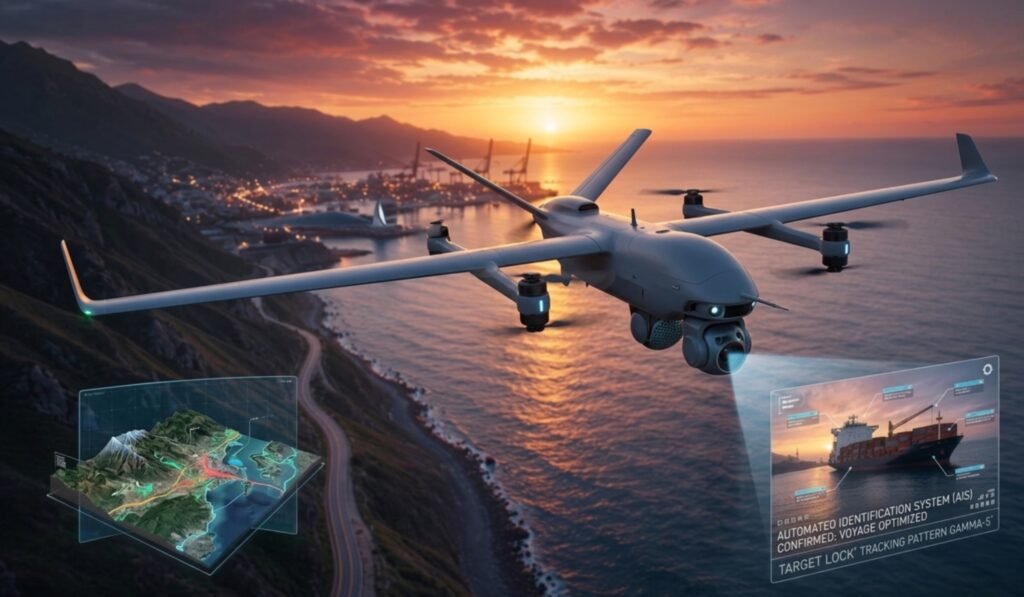
A UAV, or Unmanned Aerial Vehicle, is an aircraft that operates without a human pilot inside it. These systems are commonly called drones. Some UAVs are controlled remotely by operators. Others use autonomous software, sensors, cameras, GPS systems, and artificial intelligence to complete missions with minimal human control. Modern drones are now used far beyond military operations. Industries including agriculture, logistics, disaster management, mapping, and medical supply delivery increasingly rely on them. That shift is one reason startups see opportunity in Pakistan’s drone sector.
NICAT and Pakistan’s Startup Push
One of the biggest developments in recent years has been the launch of the National Incubation Center for Aerospace Technologies (NICAT). The incubation center officially launched in 2023 and operates from the National Aerospace Science and Technology Park (NASTP) in Rawalpindi. The project receives backing through the Ministry of IT and Telecommunication and the Ignite National Technology Fund. NICAT focuses on aerospace, robotics, artificial intelligence, cybersecurity, and deep-tech startups. Since its launch, the platform has supported dozens of startups working across advanced technology sectors. It has also helped companies secure investment commitments and commercial partnerships. For Pakistan’s startup ecosystem, this matters because aerospace companies require expensive infrastructure, specialized engineering talent, and access to testing facilities. Few founders can build that alone. Incubation platforms reduce some of those barriers.
The Startup Trying to Build Local Drone Systems
Among NICAT’s better-known startups is NEXERIN, a Rawalpindi-based company working on AI-powered drone systems. The startup recently secured around $2 million in funding from a German corporation. That alone drew attention because foreign investment into Pakistan’s aerospace sector remains rare. NEXERIN develops autonomous drone systems for several sectors. These include agriculture, rescue operations, surveillance, medical delivery, and fleet coordination. Its systems focus heavily on local customization rather than mass production. The company says that approach helps it compete against imported alternatives. Low-cost Chinese drones may dominate consumer markets, but many businesses still need maintenance support, software customization, and hardware designed for local conditions. That creates room for local engineering firms.
The Regulatory Problem
Despite growing interest, regulation remains one of the biggest obstacles. Drone development in Pakistan often requires coordination with aviation authorities, security agencies, and multiple government departments. Approval processes can be slow and unclear. Research and controlled testing are generally permitted. Commercial applications like crop monitoring and mapping also face fewer restrictions. But once projects move closer to defense applications or advanced autonomous systems, oversight becomes tighter. For startups, this creates uncertainty. A founder may spend years building technology without knowing how quickly permissions, certifications, or commercial approvals will move. Investors notice that risk too.
Why Agriculture Is Becoming Important
Many Pakistani drone startups are avoiding direct military applications at first. Instead, they are entering sectors like precision agriculture. Precision agriculture uses drones, sensors, and satellite imaging to monitor crop conditions, irrigation levels, soil quality, and pest activity. Pakistan’s agriculture sector still relies heavily on manual processes. That gives drone companies a large market if costs become affordable enough. Companies such as PakZar Zameen already use drone systems and multispectral imaging to help farmers analyze crops and improve productivity. This commercial side of the industry may become the entry point that helps local startups survive before expanding into more advanced aerospace systems.
Can Pakistan Become a Builder Instead of a Buyer?
Pakistan already imports large amounts of advanced technology. That includes surveillance systems, drone components, sensors, and industrial software. The long-term challenge is whether local startups can reduce that dependence. Right now, the ecosystem remains small. Funding is limited. Regulations remain complicated. Infrastructure gaps still exist. But the direction is changing. Universities are producing more engineering graduates. Incubation centers are expanding. Local founders are starting to build companies in areas that once felt inaccessible. Whether Pakistan becomes a serious producer of aerospace technology will depend less on announcements and more on whether startups can survive long enough to keep building.