
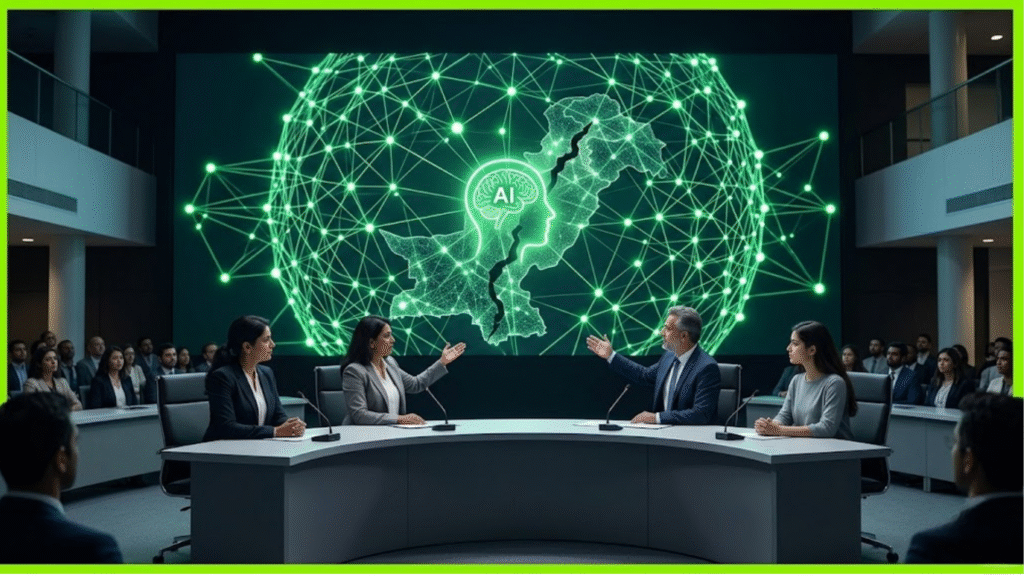
At a recent conference on gender and the economy, one topic kept coming up again and again: artificial intelligence and whether countries like Pakistan are ready for the changes that may come with it.
The discussion happened during a session titled “Health & Gender.” The panel included Warda Riaz, Fyeza Jehan, Usman Ali, Adnan Khan, and M. Farhan Majid. Much of the conversation focused on women, digital access, and how technology could reshape economic opportunities over the next few years. Some speakers sounded optimistic. Others were more cautious. One panellist said AI could open doors for women who previously had limited access to jobs or business opportunities. Online work, digital services, and automation tools may lower some of the barriers women face in traditional workplaces. At the same time, the speakers warned that technology alone does not fix inequality. If access to education and digital skills remains uneven, the gap could widen rather than narrow. Women with internet access, training, and technical knowledge may benefit quickly, while others could struggle to keep up.
The panel spent time discussing small businesses. According to the speakers, many entrepreneurs are already looking at AI tools to manage routine tasks more efficiently. Survey findings shared during the session showed that women entrepreneurs from nearly 80 countries expressed interest in generative AI systems. The research was conducted with support from the Asher Blair Foundation. A lot of interest centered around everyday business work. Things like accounting, payroll, customer replies, scheduling, and basic administration came up repeatedly during the discussion. One speaker explained that small business owners often spend too much time handling repetitive work. AI tools may reduce some of that burden, especially for businesses operating with limited staff. But even during the more hopeful parts of the discussion, concerns about access remained in the background.
Pakistan still faces literacy and connectivity challenges in many areas. Digital access also varies sharply between urban and rural communities. Several speakers noted that many women still do not have the same access to devices, training, or stable internet connections as men. That creates a problem when technology moves quickly. The panelists said AI systems usually reward people who already have technical skills. Countries and communities with weaker education systems often struggle to adapt once industries begin shifting toward automation and digital services.
The economic side of the conversation was also significant. According to estimates mentioned during the session, Pakistan’s women-focused digital economy could represent a market opportunity of around $500 million. The figure reflects how much untapped potential still exists. Yet, the speakers stressed that just having the opportunity is not necessarily what leads people to participate in the real economy. Training, infrastructure and long-term planning are as important as technology itself. The conversation moved a bit away from Pakistan when, at one point, it reached it. Speakers also pointed out that many countries are now committing significant resources to AI education, startup ecosystems and digital workforce initiatives, as technology is viewed as core to future gains in their economies.
The worry is that sluggish nation-states could become increasingly reliant on foreign platforms and imported systems rather than developing their own homegrown capacity. Towards the end of the session, this panel got back to a more basic point. If women are cut out of digital and AI-related skills, the impact may not only be seen in employment statistics. Similarly, it may decide the makeup of alternative industries in future and who is included or excluded.
The speakers called for stronger investment in affordable digital learning programs, especially for women and underserved communities. No one on the panel suggested AI itself was the problem. The concern was more about uneven access and whether enough people are being prepared for what comes next.