
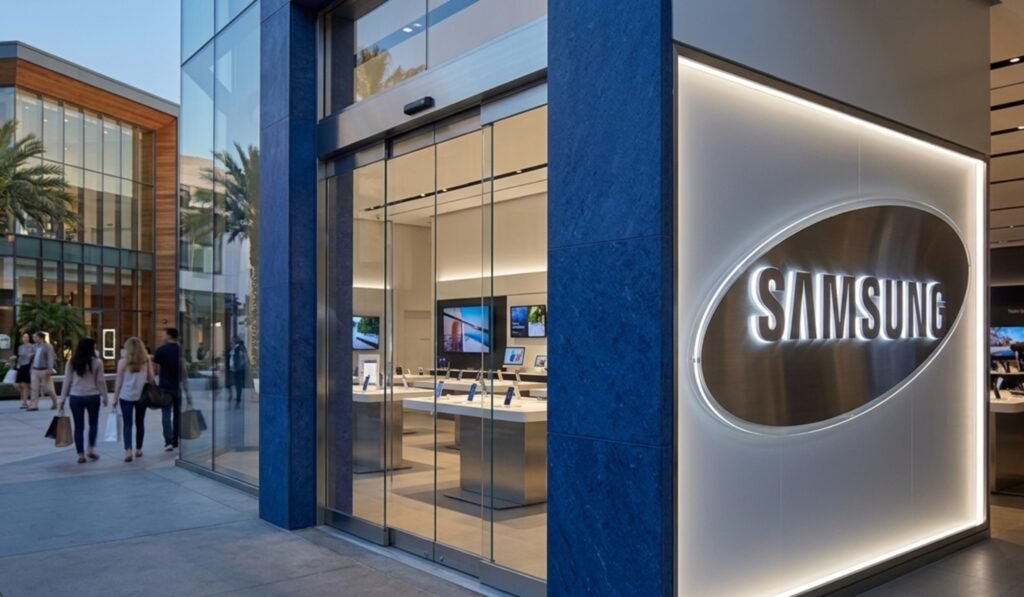
Samsung Electronics moved past the $1 trillion market value mark on Wednesday. It became only the second Asian company to reach that level. The stock jumped fast. At one point, it climbed around 13% in early trading. That pushed Samsung’s total value close to 1,500 trillion won. The timing mattered. US tech stocks tied to artificial intelligence also surged overnight. The S&P 500 and Nasdaq both closed at record highs. That global momentum fed directly into Asian markets. Investors followed the same theme everywhere. AI demand. Chips. Memory. Data centers.
KOSPI Breaks a New Level
South Korea’s stock market reacted strongly. The KOSPI index crossed 7,000 points for the first time. It kept moving and ended the session at 7,417.54, up 6.9%. The move was not broad-based. It was concentrated. Two names carried most of it. Samsung Electronics and SK Hynix. Together, they represent around 44% of the entire KOSPI market value. Both stocks rose more than 10% in a single day. Both hit new all-time highs. That tells a simple story. The index is now tightly tied to semiconductors.
AI Memory Chips Drive the Momentum
The biggest driver behind Samsung’s rise is not general electronics. It is memory chips built for AI systems. Samsung has been pushing into advanced semiconductor nodes. One focus is HBM4, a next-generation high-bandwidth memory product. Sang Joon Hwang, who leads memory development at Samsung, explained the shift. The company is moving away from older, safer designs. It is adopting advanced processes like 1c DRAM and 4nm logic technology. The idea is simple. More speed. Less delay. Better efficiency for AI workloads. He also said the goal is to meet rising demand from customers, building large AI systems.
Record Earnings Add Fuel
The stock rally also came after strong financial results. Samsung posted record numbers for the first quarter. Operating profit jumped more than eight times to 57.2 trillion won. Revenue also hit a record. It reached 133.9 trillion won. There is an unusual detail here. First-quarter profit alone exceeded Samsung’s total profit for the full year 2025, which was 43.6 trillion won. Memory chips made the difference. Especially high-bandwidth memory (HBM) is used in AI servers and data centers. But competition is not easy. SK Hynix has gained ground in this segment. Samsung lost some early leadership in HBM, even though demand is rising fast.
HBM4 and the AI Hardware Race
Samsung recently confirmed mass production of HBM4 chips. This is the sixth generation of high-bandwidth memory. It is built for speed-heavy AI workloads. These chips matter because modern AI systems move huge amounts of data between processors and memory. Standard chips are not enough anymore. HBM4 is expected to support future AI platforms, including Nvidia’s Vera Rubin architecture. That system targets large-scale data centers running advanced AI models. So the direction is clear. AI growth pushes hardware demand. Hardware pushes chip innovation.
Foreign Money Flows Into Korea
Investors outside Korea added more fuel to the rally. On Monday alone, foreign funds bought about 2.9 trillion won worth of KOSPI shares. On Wednesday, the trend continued. Net foreign buying reached 1.7 trillion won. That kind of inflow is not random. It usually follows strong global themes. Right now, that theme is AI infrastructure. There is also a shift in market access. Reports say that Interactive Brokers and Samsung Securities are working together to provide US investors with easier access to Korean stocks. That could increase global participation in Samsung and other large Korean companies.
AI Demand Is Reshaping the Market
Analysts point to one main reason behind the surge. AI demand for memory chips. AI systems require massive bandwidth. They process large datasets continuously. That creates pressure on memory performance. HBM chips solve part of that problem. They reduce delays between processing units and memory layers. But supply is limited. That imbalance pushes prices higher. It also boosts revenue for companies that can scale production. Samsung is now directly tied to that cycle.
A Shift in Samsung’s Role
Crossing a $1 trillion valuation is not just a number milestone. It reflects a shift in global tech demand. Samsung is no longer just a consumer electronics brand. It is becoming a core supplier in the AI infrastructure chain. The next phase depends on execution. More competition. Faster innovation cycles. Higher pressure on chip design. For now, the market is betting on one thing. AI growth is still early. And Samsung is positioned right in the middle of it.