

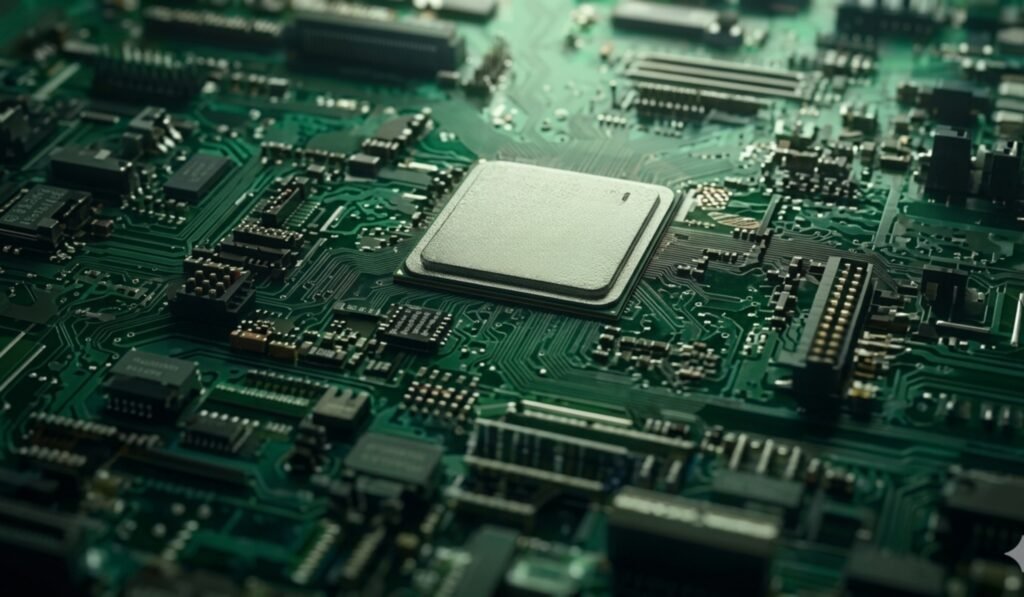
Scientists in Germany have built a new chip that pushes data handling into a new range. The work comes from the Heinz Nixdorf Institute at Paderborn University, under the PACE project. The chip uses silicon-germanium. It is designed for extremely fast signal processing. It converts analog signals into digital data. That step is where most speed limits usually appear in electronics. Researchers say this chip reaches a record in a circuit called a track-and-hold system. That part captures fast signals and freezes them for digital conversion. Without it, modern communication systems slow down quickly.
Here, the performance changes. The system crosses 500 gigabits per second (Gbps) in a single channel. That number is not common in current hardware. One gigabit equals one billion bits. So the scale is large. At 500 Gbps, around 62 gigabytes of data can move every second. That means huge file transfers in seconds, not minutes. In theory, large media libraries could shift in a very short time window.
The chip also uses quadrature amplitude modulation. This method packs more information into each signal wave. It increases efficiency without needing extra channels. When multiple channels are used together, the results scale up. The researchers estimate that total throughput can pass 100 terabits per second. That level is aimed at backbone networks, not consumer devices. Silicon-germanium plays a key role here. It behaves like silicon during manufacturing, but performs better electrically. It switches faster and wastes less energy. That balance matters. Speed alone is not enough if power use becomes too high.
One of the researchers, Maxim Weizel, described how the system works. He said transceivers sit between analog and digital systems. They handle both directions of data flow, Sending, Receiving, Both at once. He explained that higher bandwidth simply means more data moves in less time. That directly affects servers, cloud platforms, and data centers. Even small improvements scale up across global systems. But testing this kind of chip is not easy. At high frequencies, measurement becomes unstable. Tiny errors create noise. Signals can distort. Even reflections inside the system can affect results. Weizel pointed out that precision becomes critical at this level. Small mistakes show up as phase noise or signal errors.
To handle that, the team used simulations instead of relying only on physical testing. High-performance computing systems helped model the chip before full validation. This reduces risk during design. It also improves accuracy before manufacturing. The motivation behind the research is not just speed for its own sake. Data demand keeps rising. AI systems process large datasets. Cloud platforms run constant communication between servers. Real-time services need instant response. Delays create bottlenecks. Weizel noted that AI especially benefits from higher-speed systems. Training models and moving data across clusters depend on fast transfer rates. If bandwidth increases, processing becomes smoother.
That is where this chip fits in. It does not replace existing systems yet. It shows what future hardware could look like. Another important point is material choice. Silicon has been used for decades. It is reliable and cheap to produce. Adding germanium improves performance without changing the whole manufacturing system.
That makes the technology more practical for scaling later. The research also hints at what comes next in communication systems. 6G research, AI hardware, and advanced cloud infrastructure all need faster data movement. Software alone cannot solve those limits anymore. Hardware changes are becoming necessary. This chip is still part of early-stage research, but it gives a clear direction. Faster data handling, lower delay, and higher efficiency may define the next generation of computing systems. For now, it stays in labs. But the target is clear.