
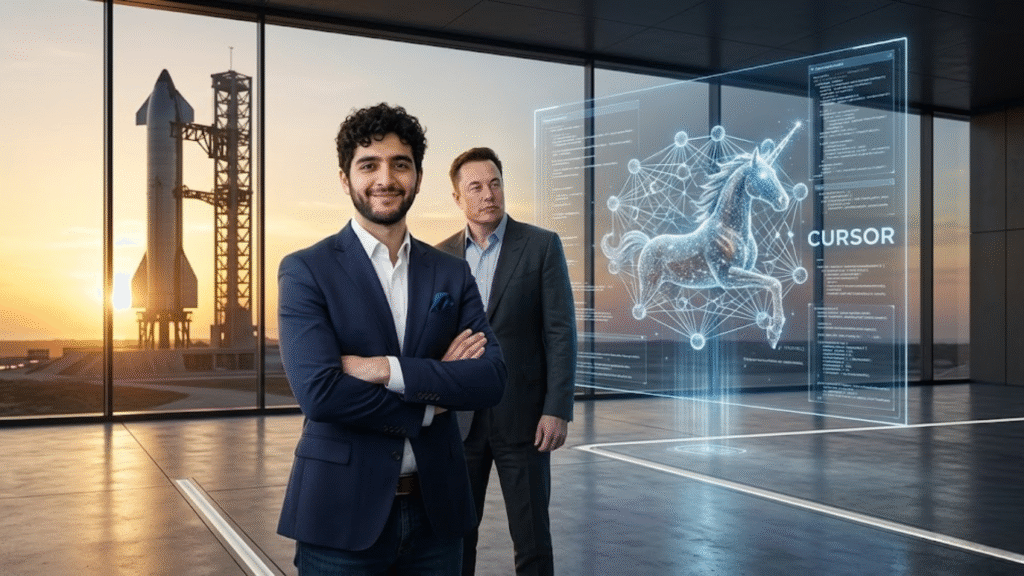
In a significant development that highlights the growing global footprint of Pakistani talent in the technology sector, a startup co-founded by a Pakistani entrepreneur has reportedly caught the attention of SpaceX for a potential artificial intelligence (AI) deal valued at an astounding $60 billion. This move, if finalized, would not only mark one of the largest AI collaborations in recent history but also position Pakistan-origin innovators at the forefront of next-generation technological transformation.
The deal revolves around advanced AI capabilities that are expected to play a critical role in optimizing large-scale aerospace operations, satellite communications, and possibly even deep-space exploration. As SpaceX continues to expand its ambitions, from satellite internet services to interplanetary missions—the integration of cutting-edge AI systems has become increasingly essential. The startup in question has reportedly developed sophisticated AI models capable of handling complex data analysis, predictive simulations, and autonomous decision-making systems, making it an ideal partner for such futuristic initiatives.
What makes this story particularly compelling is the Pakistani connection behind the startup. The co-founder, whose roots trace back to Pakistan, represents a growing wave of South Asian entrepreneurs who are reshaping global tech narratives. Over the past decade, Pakistani professionals have steadily gained recognition in Silicon Valley and beyond, contributing to major breakthroughs in AI, fintech, cybersecurity, and cloud computing. This potential deal further reinforces the idea that talent from Pakistan is not just participating in the global tech ecosystem but actively leading it.
From a strategic perspective, this collaboration could redefine how AI is deployed in aerospace engineering. Traditional systems rely heavily on human-led decision-making and static programming, but AI introduces a dynamic layer of intelligence that can adapt in real time. For instance, AI-powered systems can optimize rocket launches by analyzing weather patterns, fuel efficiency, and trajectory adjustments within seconds. Similarly, satellite networks—such as those operated by SpaceX, can benefit from AI-driven automation to enhance connectivity, reduce latency, and predict system failures before they occur.
Moreover, the scale of the proposed $60 billion deal underscores the increasing value of AI in the global economy. Artificial intelligence is no longer confined to research labs or niche applications; it has become a cornerstone of innovation across industries. From healthcare and finance to transportation and defense, AI is driving efficiency, reducing costs, and unlocking new possibilities. In this context, the involvement of a Pakistani co-founded startup in such a high-stakes deal signals a shift in how emerging markets are perceived—not merely as consumers of technology but as creators and innovators.
For Pakistan, this development carries both symbolic and practical significance. On one hand, it serves as a source of national pride, showcasing the potential of Pakistani talent on the world stage. On the other hand, it highlights the importance of investing in education, research, and entrepreneurship to nurture future innovators. With the right support systems in place, Pakistan could position itself as a hub for AI development, attracting global partnerships and investments.
The ripple effects of this deal could extend far beyond the immediate stakeholders. For instance, it may inspire young entrepreneurs in Pakistan to pursue careers in technology and innovation, knowing that global opportunities are within reach. It could also encourage policymakers to prioritize digital transformation and create an environment conducive to startups. Additionally, collaborations of this magnitude often lead to knowledge transfer, enabling local ecosystems to benefit from global expertise.
However, it is important to approach this development with a balanced perspective. While the potential deal is promising, it is still subject to negotiations, regulatory approvals, and technical validations. Large-scale partnerships in the tech industry often face challenges related to integration, scalability, and security. Ensuring that AI systems are reliable, ethical, and aligned with global standards will be crucial for the success of this collaboration.
Another aspect worth considering is the broader geopolitical context. As AI becomes a strategic asset, countries and corporations are increasingly competing to secure technological leadership. Partnerships like this one could influence global power dynamics, shaping how technology is developed and deployed in the المستقبل. For Pakistan, being associated with such a high-profile deal could enhance its reputation as a contributor to global innovation.
In conclusion, the reported interest of SpaceX in a $60 billion AI deal with a startup co-founded by a Pakistani entrepreneur represents a landmark moment for both the global tech industry and Pakistan’s innovation landscape. It reflects the growing importance of AI as a transformative force and highlights the role of diverse talent in driving progress. Whether or not the deal materializes, the mere possibility of such a collaboration sends a powerful message: innovation knows no boundaries, and talent, regardless of its origin, can shape the future of technology.