

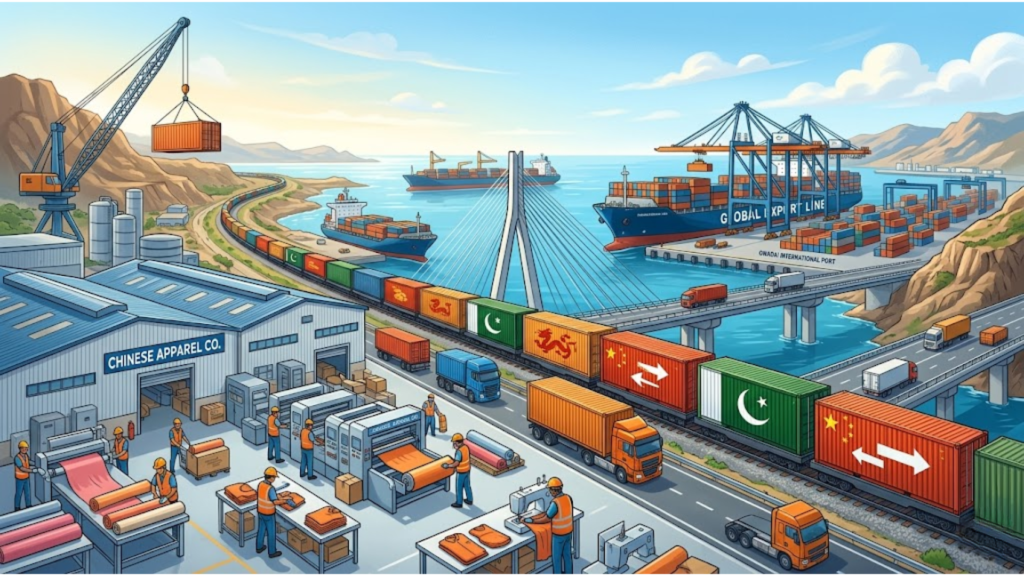
Chinese clothing manufacturer Challenge Fashion is moving ahead with a large expansion project in Pakistan. The company says it wants to build a long-term export operation that could eventually generate between $400 million and $500 million every year. The plan came up during a recent meeting between Commerce Minister Jam Kamal Khan and a Chinese business delegation led by Challenge Fashion Chairman Huwang and Challenge Apparel CEO Karen Chen. The conversation covered exports, manufacturing, tariffs, and industrial cooperation between Pakistan and China.
Large Factory Project Underway
Challenge Fashion is already developing a manufacturing facility in Pakistan. Company officials say the project is being built according to international production and safety standards. The first phase is expected to finish later this year. People involved in the talks described the project as one of the company’s biggest regional manufacturing plans so far. If the expansion continues as planned, the facility could create around 20,000 jobs over time. That number matters because Pakistan’s textile and apparel industry remains one of the country’s largest employment sectors.
Earlier Investment Plans
The latest expansion is not the company’s first announcement linked to Pakistan. Last year, Challenge Fashion revealed plans to invest nearly $100 million over five years to develop a dedicated Special Economic Zone (SEZ) in the country. At the time, the announcement attracted attention because more Chinese manufacturers have started looking outside China for additional production capacity. Pakistan has become part of that discussion due to its textile industry, workforce, and location near regional trade routes.
Why Pakistan Is Attracting Interest
During the meeting, the Chinese delegation spoke about Pakistan’s advantages for export manufacturing. Labor costs were one reason. The delegation also pointed to Pakistan’s location and its access to regional trade corridors connecting South Asia, the Middle East, and nearby markets. Commerce Minister Jam Kamal Khan said global supply chains are changing and countries like Pakistan now have a chance to attract more export-focused investment. Over the last few years, several countries have tried to position themselves as alternative manufacturing destinations as international companies rethink supply chains after disruptions in global trade.
Company Raises Import Concerns
The meeting was not only about expansion plans. The delegation also discussed some operational problems linked to the project. According to company representatives, certain specialized construction materials needed for the factory are not available locally. They said those products are necessary to meet international industrial and safety standards.
As a result, the company may need to import certain materials during the construction phase. The delegation requested government support on tariffs and import procedures for those items. In response, the commerce minister asked the company to formally submit product details and tariff classifications so the issue could be reviewed under Pakistan’s tariff rationalization process. Officials suggested that temporary imports for industrial projects could eventually help local industries produce similar materials as demand increases.
Government Promises Support
Host country government officials pledged their continued support for industrial investment projects to the visiting delegation. Pakistan has integrated multi-industry tariff reviews into its overall development initiatives aimed at cutting costs and boosting competitiveness. The discussion for this project includes four categories of practical work matters: land approval, infrastructure construction, public utilities, and the implementation of special economic zone projects. The country’s official authorities have formally launched a new foreign investment policy that streamlines administrative procedures and reduces waiting periods.
Focus on Trade and Logistics
Later in the meeting, they talked about logistics, access to energy and regional trade routes. Officials said transportation is crucial for export industries. Powerful trade corridors allow businesses to ship products more seamlessly across borders. They further stated that better regional connectivity might facilitate Pakistan in securing more manufacturing projects over the years. The project could turn out to be one of Challenge Fashion’s biggest regional operations in the future. Pakistani officials consider it one of the components of a broader strategy to boost exports, industry and job creation.