
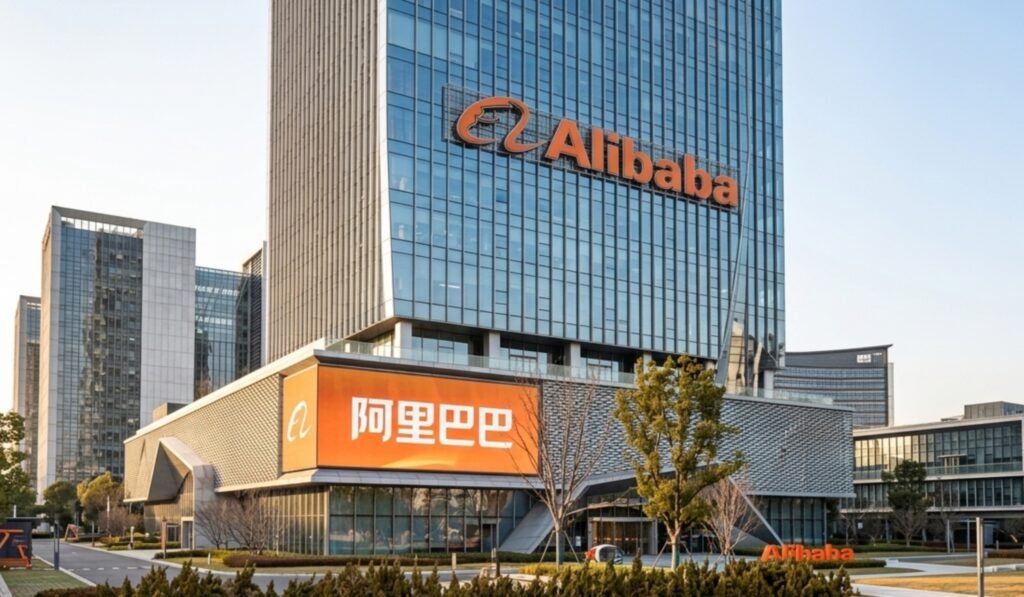
The global AI landscape is no longer a two-horse race between the US and Europe. In 2026, the spotlight has shifted dramatically to the East. China’s tech titan, Alibaba, is waging an all-out war on the AI sector, leading what many analysts call the “China AI Revolution.”
For the past two years, Silicon Valley giants like OpenAI and Google dominated the headlines with GPTs and Geminis. However, a seismic shift in the leaderboards has occurred. With the release of the Qwen 3.7-Max model, Alibaba has not only closed the gap but has surpassed its US rivals in some of the most critical metrics of the modern AI era.
The pressing question for tech enthusiasts in Pakistan and globally is simple: Can Alibaba actually beat OpenAI?
The Benchmark Shake-Up: Coding Supremacy
To understand how fierce this race is, we have to look at the raw data. For a long time, OpenAI’s GPT series was the default gold standard. But in late May 2026, the Code Arena leaderboard—a benchmark that tests how well AI builds real-world web applications rather than just solving LeetCode puzzles—dropped a bombshell .
Alibaba’s Qwen3.7-Max scored 1,541 points, ranking 4th globally and 2nd among publicly available models. Here is the kicker: It demolished GPT-5.5 and Google’s Gemini 3.5 Flash . In the Asia-Pacific region, it was ranked number one, signaling a major shift in the balance of power.
Unlike traditional tests, Code Arena uses blind votes from developers on anonymized model outputs. It tests if an AI can build an interactive dashboard or a browser game from scratch. In this arena, Qwen proved it isn’t just a chatbot; it is an agentic engineer. It reportedly can work autonomously for 35 hours straight, compressing two weeks of human development work into a single afternoon .
Why This Matters for Pakistan
For our local developers and startups, this is a game-changer. The barrier to entry for SaaS development is collapsing. If Chinese models can deliver code at this quality for a fraction of the cost of US APIs, we could see a massive shift in which cloud ecosystems the Pakistani tech industry relies on.
The Different Paths: Strategy vs. Strategy
While the benchmark scores are sexy, the real battle is in strategy. OpenAI and Alibaba are taking radically different roads to get to the finish line.
1. OpenAI: The “New iPhone” Gambit
Sam Altman’s OpenAI is aiming for the consumer hardware crown. They are partnering with Jony Ive (the designer of the iPhone) to create a “post-smartphone” AI device . Their strategy hinges on creating a closed, premium ecosystem where the AI is the operating system of new physical hardware.
2. Alibaba: The “Super Cloud” and Total Integration
Alibaba is playing a different game. They aren’t just building a model; they are building the entire continent. CEO Eddie Wu has doubled down on a “chip-cloud-model-inference” full-stack upgrade .
- The Investment: They are investing a staggering 380 billion RMB into “Super AI Cloud” infrastructure .
- The Integration: Alibaba is aggressively stuffing AI into everything.
- E-commerce: AI “shopkeepers” and agents manage inventory and customer service on Taobao and Tmall autonomously .
- Logistics: Cainiao’s smart fulfillment is driven by Qwen models.
- Mapping: Gaode Maps is evolving into a spatial intelligence platform .
Essentially, while OpenAI wants to invent a new device, Alibaba wants to be the invisible operating system for every screen and business in Asia.
The “Small Model” Trend: Alibaba’s Secret Weapon
We often assume bigger is better. However, Alibaba is winning the “efficiency race.”
In early March 2026, the industry saw a flurry of releases. OpenAI dropped GPT-5.3 Instant for speed, and Google dropped Gemini Flash. But Alibaba shipped the Qwen 3.5 Small series (from 0.8B to 9B parameters) .
Why is this significant? These “small” models can run directly on a smartphone or a laptop without needing the cloud. This is revolutionary for privacy, latency, and cost.
Alibaba has mastered the art of Scaled Reinforcement Learning, allowing a 9-billion-parameter model to compete with models five times its size . For Pakistani enterprises with limited high-speed internet bandwidth, an on-device AI that speaks Urdu and English is far more practical than a cloud-reliant giant.
The Verdict: Who is Winning?
According to a recent Morgan Stanley survey of CIOs, Alibaba is currently perceived as the “largest winner” in the Chinese AI race, pulling ahead of competitors like Baidu and Tencent . But can they beat OpenAI?
The answer depends on the definition of “win.”
- If winning means Raw Intelligence: The gap is closing. Alibaba’s Qwen models are now statistically neck-and-neck with GPT-5.5 on coding and logic. In some specific reasoning tasks, they have already won .
- If winning means Market Share: Alibaba has a massive advantage. They have a built-in ecosystem of 1 billion+ users via e-commerce. They don’t need to sell a gadget; they just upgrade the app you already use to pay for groceries.
- If winning means Global Influence: OpenAI still has the edge in the Western consciousness and enterprise stack. However, in the “Global South” (including parts of the Middle East, Africa, and Asia), Alibaba Cloud is aggressively positioning Qwen as the more affordable, accessible option.
My analysis? Alibaba has effectively caught up to OpenAI in applied AI (coding, agentic workflow). However, OpenAI’s head start in multimodal video generation and speculative “Super Intelligence” research keeps them slightly ahead in long-term hype.
For the rest of us, particularly the tech community at TechInPakistan, the real victory is competition. The rivalry between these titans is driving prices down and capabilities up faster than ever before.
Looking Ahead: What to Watch in 2026
We are currently in a “Deployment Phase” of AI. Here is what you should keep an eye on:
- Agentic Workflows: Can you give an AI a goal (like “book a flight and hotel under $500”) and have it execute across multiple apps? Both Alibaba and OpenAI are racing here.
- Cost of Inference: Alibaba has a reputation for being cheaper. As US sanctions on chips continue, China is being forced to innovate on efficiency. This “scarcity advantage” might actually make Alibaba’s models leaner and cheaper to run.
- Local Language Support: For Pakistan, the model that best handles Urdu and regional dialects will win the local market. Alibaba’s experience with complex Asian languages gives them a potential edge over OpenAI.
What do you think? Is Alibaba ready to dethrone OpenAI, or is Sam Altman’s lead insurmountable?
Share this post with your network and let us know in the comments below!