

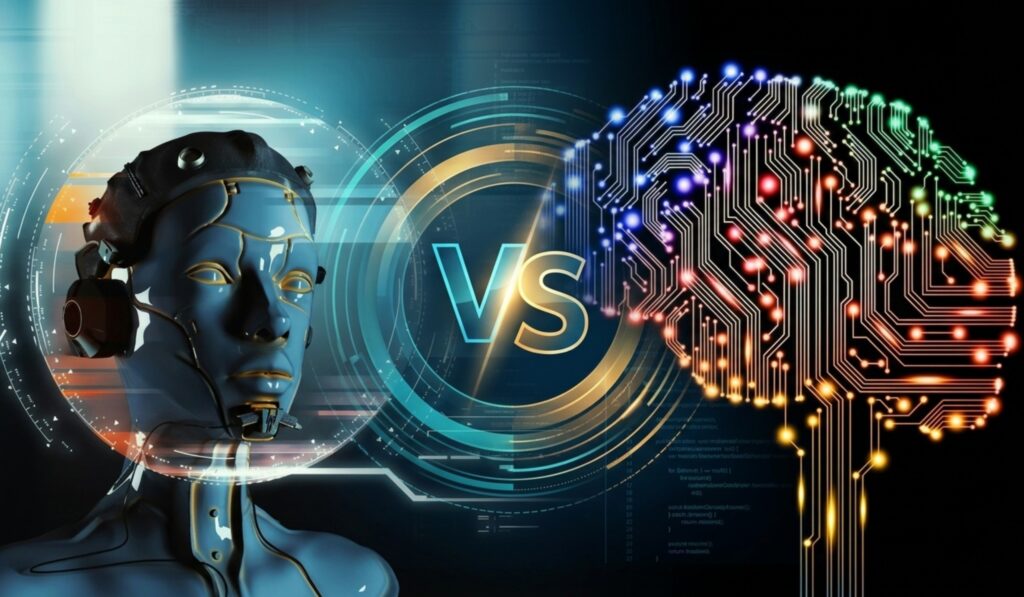
Machine Learning (ML) and Deep Learning (DL) are both branches of Artificial Intelligence (AI), but they differ in how they learn from data and solve problems.
| Feature | Machine Learning | Deep Learning |
|---|---|---|
| Definition | A subset of AI that enables systems to learn from data and improve over time. | A subset of Machine Learning that uses artificial neural networks with multiple layers to learn complex patterns. |
| Data Requirement | Works well with smaller datasets. | Requires large amounts of data for optimal performance. |
| Feature Engineering | Humans often need to identify and select relevant features. | Automatically extracts features from raw data. |
| Training Time | Generally faster to train. | Usually requires much longer training times. |
| Hardware Needs | Can run on standard computers. | Often requires powerful GPUs or specialized hardware. |
| Interpretability | Easier to understand and explain decisions. | Often considered a “black box” due to its complexity. |
| Best For | Structured data such as sales records, customer information, and financial data. | Unstructured data such as images, videos, audio, and natural language. |
Machine Learning in Simple Terms
Machine Learning teaches computers to learn patterns from historical data and make predictions without being explicitly programmed.
Example:
Suppose you want to predict whether a customer will purchase a product based on:
- Age
- Income
- Previous purchases
A machine learning model analyzes past customer data and learns patterns to predict future buying behavior.
Common Machine Learning Algorithms:
- Linear Regression
- Logistic Regression
- Decision Trees
- Random Forest
- Support Vector Machines (SVM)
- K-Nearest Neighbors (KNN)
Deep Learning in Simple Terms
Deep Learning uses artificial neural networks inspired by the human brain. These networks contain multiple layers that process information and learn increasingly complex patterns.
Example:
If you want a computer to recognize cats in images:
- A machine learning model would require humans to define features such as ear shape, whiskers, or fur patterns.
- A deep learning model learns these features automatically by analyzing thousands or millions of images.
Common Deep Learning Models:
- Artificial Neural Networks (ANN)
- Convolutional Neural Networks (CNN)
- Recurrent Neural Networks (RNN)
- Transformers
Real-World Applications
Machine Learning
- Spam email detection
- Credit scoring
- Sales forecasting
- Customer segmentation
- Recommendation systems
Deep Learning
- Facial recognition
- Self-driving cars
- Voice assistants
- Medical image analysis
- Generative AI tools such as ChatGPT and Google Gemini
A Simple Analogy
Imagine teaching a child to identify fruits:
Machine Learning:
You explain the rules:
- Apples are usually red or green.
- Bananas are yellow and curved.
The child uses those rules to identify fruits.
Deep Learning:
Models in Deep Learning operate by being presented with countless images which enable͏s the system to independently recognize features (i-e; traits) without needing specific programming rules. Engaging in this repeated practice Deep Learning builds a self-sufficient comprehension of intricate patterns.
Conclusion
Machine Learning works best with organized data (i-e; data that fits neatly into tables) while Deep Learning shines when dealing with vast unstructured content such as audio and written text. Significant computing resources and large datasets are necessary for Deep Learning making it suitable only for complex projects. Traditional Machine Learning still performs well on specific tasks; however Deep Learning provides greater efficiency in tackling advanced needs. Deep Learning thus stands out as a robust and resource-heavy method for contemporary artificial intelligence.