
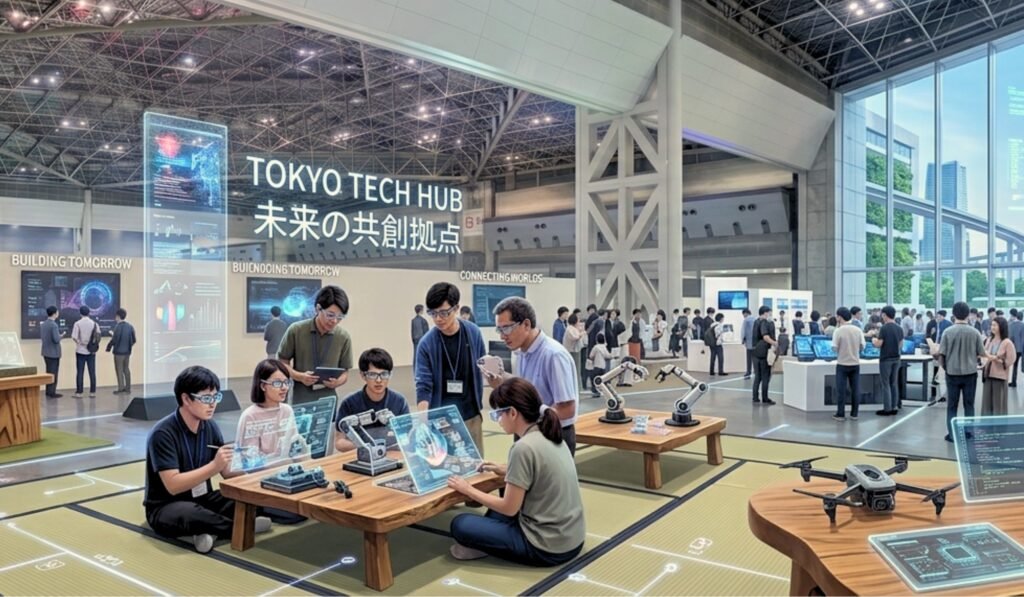
As the global tech landscape shifts toward new centers of gravity, one city is emerging as the undeniable powerhouse for 2026: Tokyo. While Silicon Valley, Bengaluru, and Shenzhen have dominated headlines for years, Japan’s capital is quietly orchestrating a technological renaissance that will make it the most important tech destination of 2026.
From government-backed deep-tech funding and AI deregulation to a booming startup ecosystem and world-class infrastructure for quantum computing, Tokyo is not just catching up, it is leaping ahead. Whether you are a founder, developer, venture capitalist, or cybersecurity expert, understanding why Tokyo matters now will determine your next big move.
This blog explores the key drivers behind Tokyo tech hub 2026 status, including Japan startup ecosystem growth, artificial intelligence innovation Japan, and the city’s unmatched advantage in hardware-software integration.
The Perfect Storm: Policy, Capital, and Culture
Tokyo’s rise is no accident. The Japanese government has launched ambitious initiatives under the “Startup Development Five-Year Plan” first introduced in 2022, which is now bearing full fruit in 2026. Key policy shifts include:
- Visa reforms – A new “J-Skip” visa for highly skilled tech professionals, granting permanent residency in just one year.
- Deregulation of crypto and Web3 – Tokyo now hosts the world’s most progressive legal framework for digital assets.
- ¥10 trillion (approx. $67 billion) deep-tech fund – Direct government investment into AI, robotics, biotech, and quantum computing.
These policies have transformed Tokyo tech ecosystem into a magnet for global talent. According to the Japan External Trade Organization (JETRO), foreign tech workers in Tokyo increased by 47% between 2024 and 2026 alone.
Tokyo vs. Silicon Valley: The 2026 Advantage
For years, Silicon Valley was the undisputed king of tech. But in 2026, Tokyo offers three distinct advantages that California cannot match:
| Factor | Silicon Valley | Tokyo (2026) |
|---|---|---|
| Cost of living (engineer) | $120k+ annually | $65k (with subsidies) |
| Government R&D grants | Limited | Extensive (up to 50% coverage) |
| Hardware ecosystem | Weak | World’s strongest |
| AI regulation | Restrictive | Pro-innovation sandboxes |
For deep-tech startups working on robotics, semiconductors, or industrial AI, Tokyo innovation district such as Tokyo Innovation Base in Toranomon and Kashiwa-no-ha Smart City provide lab space, prototyping facilities, and direct access to manufacturing giants like Sony, Hitachi, and Toyota.
The Rise of AI and Generative Tech in Tokyo
Artificial intelligence innovation Japan has exploded in 2026, with Tokyo as its epicenter. Unlike Western markets, where regulatory fears dominate, Japan has embraced AI with clear, business-friendly rules. The country’s “light-touch” AI governance model has attracted companies like Stability AI, Anthropic, and Mistral to open their Asia-Pacific headquarters in Tokyo.
Local unicorns are also thriving. Preferred Networks (PFN) , Japan’s most valuable AI startup, has partnered with the Tokyo Metropolitan Government to deploy generative AI for public services, from automated disaster response to AI-powered traffic management ahead of major events.
The Hardware Advantage: Robotics and Semiconductors
No other tech hub in the world matches Tokyo’s concentration of robotics and semiconductor expertise. While software-focused hubs struggle with supply chains, Tokyo sits at the heart of global chip manufacturing, thanks to TSMC’s new fab in Kumamoto (just 90 minutes by Shinkansen) and Rapidus’s advanced 2nm chip project in Hokkaido.
In 2026, Tokyo robotics companies like Mujin (logistics automation), Telexistence (remote-controlled robots), and Kawasaki Heavy Industries are leading a new wave of humanoid robots for healthcare and manufacturing. The annual International Robot Exhibition (iREX) in Tokyo has become the world’s largest trade show for automation, surpassing Hannover Messe.
For hardware engineers and OT security experts, Tokyo offers unparalleled opportunities. Learn more in our post: why OT security professionals are moving to Tokyo in 2026 (inbound link placeholder).
Startup Ecosystem: Japan’s Unicorn Factory
The Japan startup ecosystem has matured dramatically. In 2025 alone, Tokyo produced 14 new unicorns, including:
- SmartHR (HR tech, valued at $2.5B)
- PayPay (fintech, $10B+)
- Spiber (biotech materials, $1.2B)
What makes Tokyo unique is the corporate venture capital (CVC) network. Giants like Mitsubishi, Sumitomo, and SoftBank actively fund and mentor early-stage startups. Unlike the “move fast and break things” culture elsewhere, Tokyo offers patient capital, founders get 7–10 year runways instead of 3–5 year exits.
Venture capital inflows to Tokyo tech hub 2026 reached $18 billion in the first half of 2026, a 200% increase from 2023 levels. According to Crunchbase data on Japan tech funding, Tokyo now ranks third globally behind only the Bay Area and Beijing.
Talent, Lifestyle, and Global Connectivity
Beyond business, Tokyo offers an unmatched quality of life. In 2026, the city ranks #1 in the Global Startup Relocation Index for:
- Safety – Lowest crime rate among major tech hubs.
- Public transit – World’s most efficient metro system.
- Healthcare – Universal coverage with English-friendly hospitals.
- Digital nomad visa – New 6-month visa for remote tech workers.
For families, Tokyo’s international schools and clean environment make it a top choice for relocating CTOs and engineers. The city also hosts Tokyo Tech Week (April 2026) and SusHi Tech Tokyo 2026, a global innovation conference expected to draw 50,000 attendees.
Challenges and How Tokyo Is Solving Them
No city is perfect. Tokyo still faces:
- Language barrier – Though improving, Japanese remains essential for local partnerships.
- Risk aversion – Some legacy corporations move slowly.
- Housing costs – Rising in central wards like Minato and Chiyoda.
However, the Tokyo Metropolitan Government has launched the “Tokyo Global Innovation Hub” initiative, offering subsidized office space, free translation services, and a dedicated English-language concierge for foreign founders. Additionally, Tokyo’s official business support portal now provides step-by-step guides for company registration, banking, and visa processing, all in English.
Why You Should Be in Tokyo by 2026 (If Not Sooner)
The window of opportunity is now. Early movers in Tokyo’s tech scene are securing prime office space, forming partnerships with keiretsu giants, and hiring top-tier talent before salaries inflate. By late 2026, experts predict Tokyo will surpass both London and Singapore in tech job postings.
Whether you work in AI, cloud computing, cybersecurity, robotics, or fintech, Tokyo offers:
- Government grants covering up to 50% of R&D costs.
- Access to manufacturing impossible elsewhere.
- A safe, clean, and efficient living environment.
- Pro-business regulations that reward innovation.
In 2026, the center of gravity for global technology will not be California or China. It will be Tokyo.