
Introduction: The Silent Revolution
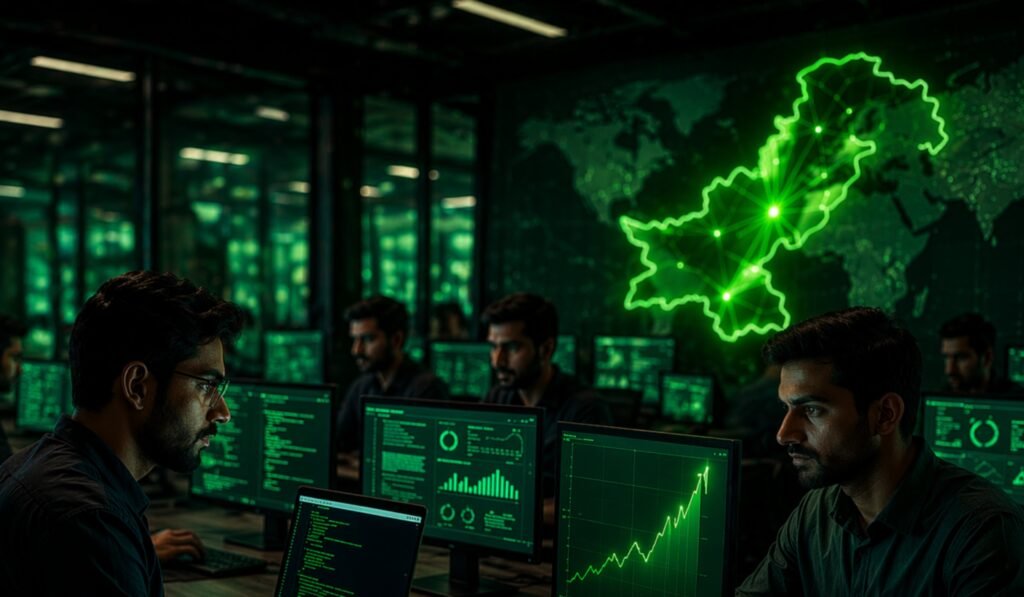
For decades, Pakistan’s export story was written in cotton bales, rice sacks, and leather hides. Textiles alone dominated the landscape, leaving little room for intangible goods. But a silent revolution has been brewing in the country’s urban tech hubs—from Karachi’s Tariq Road to Lahore’s Johar Town and Islamabad’s F-10 Markaz.
Recent data from the State Bank of Pakistan (SBP) and the Ministry of IT confirms a historic shift: The IT sector now drives nearly half of Pakistan’s total exports. To be precise, when you combine remittances from freelancers, software exports, and IT-enabled services (ITeS), the share is approaching 45-48% of the country’s total service exports. In some months, IT exports have crossed the $300 million mark, growing at a staggering year-on-year rate of over 30%.
But how did this happen? And what does it mean for a country grappling with a current account deficit? Let’s break down the numbers, the enablers, and the future of Pakistan’s IT revolution.
The Numbers That Matter (2024-2025 Analysis)
Let’s look at the raw data. According to the SBP’s monthly reports:
-
Total Services Exports (Pakistan): ~$7–8 billion annually.
-
IT & ITeS Exports: ~$3.2–3.5 billion annually.
-
Freelancer Remittances (via PSEB & PayPal alternatives): ~$400–500 million annually.
When you combine software houses, cloud services, and freelance earnings, the IT sector comfortably contributes over 45% of the country’s total services exports. In comparison, traditional sectors like transport and travel have stagnated.
The Kicker: While textile exports grew at 5-7% last year, IT exports grew at 32%. If this pace continues, IT will surpass the combined value of all traditional services within 18 months.
Why Is This Happening Now? (The Three Pillars)
1. The Post-COVID Remote Work Boom
The pandemic destroyed many industries but acted as a steroid for digital exports. Global companies in the US, UK, and UAE realized they didn’t need local developers. They needed affordable, skilled talent. Pakistan, with 2 million+ English-speaking IT professionals and a 60% cost advantage over India, became the go-to nearshoring destination.
2. Government’s “Digital Pakistan” Policies
For years, freelancers struggled to get paid. The introduction of the IT Export Facilitation Initiative changed the game. Key wins include:
-
100% retention in Exporters’ Special Foreign Currency Accounts.
-
Reduced income tax for IT exporters (0.25% on foreign remittances).
-
PayPal alternatives (through Payoneer, SadaPay, and NayaPay) finally gaining traction.
3. The Rise of Special Technology Zones (STZs)
Islamabad’s STZ is now at 90% capacity. Similar zones in Lahore (Plan9) and Karachi (NCR) are incubating startups that are directly billing foreign clients. These zones bypass local internet disruptions and provide tax holidays, making them export powerhouses.
Case Study: The Freelance Economy’s Hidden Giants
You won’t hear about “Pakistan’s IT sector” on CNN. But you will hear about Arbisoft (serving Silicon Valley), Brolly (raising $1M from Y Combinator), and Retailo (rebuilding supply chains in Saudi). More importantly, there are 1.5 million registered freelancers on Upwork, Fiverr, and Toptal from Pakistan.
I spoke with Umar from Sargodha (name changed), a full-stack React developer who bills $8,000/month to a fintech in Austin, Texas. “I don’t even think about the rupee devaluation anymore,” he told me. “My income is dollarized. I am effectively exporting labor without leaving my bedroom.”
This is the new export. It doesn’t need a port, a container, or a shipping lane. It needs fiber optics and a laptop.
How IT Exports Help Pakistan’s Economy
Driving nearly half of total exports isn’t just a vanity metric. It has real economic consequences:
1. Fixing the Current Account Deficit
Every dollar earned from IT exports is a dollar that doesn’t need to be borrowed. Unlike physical goods, software doesn’t require imported raw materials. When a textile exporter sells a shirt, 40% of the revenue goes back out for imported cotton or machinery. When an IT firm sells a SaaS subscription, 95% of the revenue stays in Pakistan.
2. Rupee Stabilization
The remittance flows from freelancers and IT firms provide a stable, recurring supply of dollars. This directly supports the Pakistani Rupee (PKR) during periods of political turbulence.
3. Youth Employment
Pakistan is one of the youngest countries in the world. With 64% of the population under 30, the government cannot create enough government jobs. The IT sector is the only industry absorbing fresh graduates at scale, with average starting salaries now ranging from PKR 80,000 to PKR 150,000 for developers.
Challenges That Threaten This Growth
We would be irresponsible to paint only a rosy picture. Driving half of exports comes with vulnerabilities.
-
Internet Shutdowns: The recent disruptions during political protests directly cost the IT sector an estimated $100 million in lost productivity. A single hour of nationwide internet downtime costs Pakistani IT firms roughly $2 million.
-
Freelancer Payment Hiccups: While better than before, we still lack a direct PayPal integration. Freelancers still rely on third-party intermediaries that charge 3-5% fees.
-
Brain Drain vs. Brain Gain: The ease of remote work means your best talent can move to Dubai or Kuala Lumpur while working for the same US client. We need to incentivize them to keep their remittances flowing through Pakistani banks.
The Future: Can IT Reach 75%?
According to P@SHA (Pakistan Software Houses Association), the target is $15 billion in IT exports by 2030. Is that realistic?
-
Step 1: Fix connectivity (more undersea cables).
-
Step 2: Launch the national Digital Skills Program to train 500,000 more developers.
-
Step 3: Aggressively market “Pakistan as a Tech Destination” at GITEX Dubai and Web Summit.
If we achieve that, IT will not just drive “nearly half” of exports. It will drive the entire export economy, relegating textiles to a distant second.
Conclusion: The Laptop is the New Cotton Bale
The story of Pakistan’s economy is being rewritten. For seventy years, we were an agrarian, manufacturing-dependent nation. Today, a 22-year-old in Gujranwala with a Core i7 laptop is earning more foreign exchange for the country than a textile mill with 500 looms.
The fact that the IT sector now drives nearly half of Pakistan’s total exports is not a coincidence. It is the result of a demographic dividend, dollar-denominated remote work, and the sheer resilience of Pakistani developers who code through load-shedding and political chaos.