

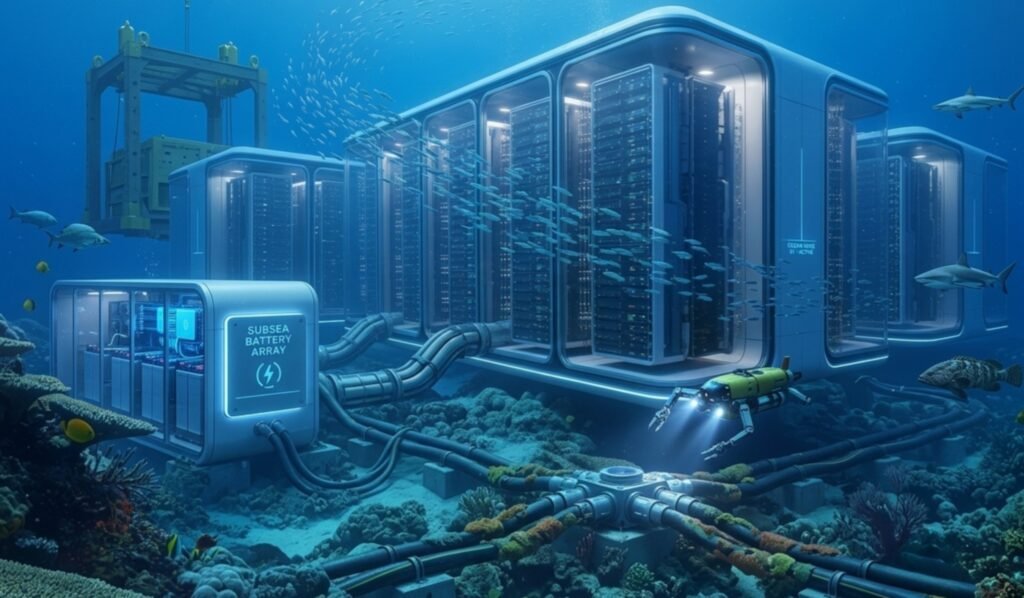
China has officially started commercial operations for what it describes as the world’s first offshore wind-powered underwater data center. The facility is located near Shanghai’s Lingang Special Area and sits around 35 meters below the ocean surface. The project combines two areas China has been investing in heavily in recent years. Artificial intelligence infrastructure and renewable energy. The underwater facility reportedly cost around $226 million and contains nearly 2,000 servers. Most of its electricity comes from a nearby offshore wind farm with more than 200 turbines. According to project details, over 95% of the center’s power supply is linked to offshore wind energy.
The project moved forward through cooperation between Lingang Special Area authorities, Shanghai Lingang Special Area Investment Holding Group, and HiCloud Technology. Several other companies later joined operational agreements, including Shanghai Telecom and Shenergy Group. Construction was completed in late 2025 after earlier testing phases in other regions of China. One of the main reasons behind the underwater setup is cooling. Traditional AI data centers consume massive amounts of electricity, and a large share of that power goes toward cooling systems. In some facilities, cooling alone can account for half of total energy usage. China’s underwater approach tries to solve that problem differently. Instead of relying heavily on mechanical cooling systems, the project uses surrounding seawater to remove heat generated by servers.
HiCloud Technology explained that hot air from the servers changes refrigerant inside copper pipes from liquid into gas. That gas naturally rises upward through buoyancy before reaching a cooling layer where seawater helps transfer the heat out. Once cooled, the refrigerant turns back into liquid and flows downward again through gravity. The company says this process creates a cooling cycle that needs little additional power. Project operators claim the underwater facility has achieved a Power Usage Effectiveness (PUE) rating of around 1.15. In the data center industry, lower PUE numbers usually indicate better energy efficiency. Traditional facilities often operate closer to 1.5 or higher.
Officials involved in the project estimate the cooling system cuts energy demand significantly compared to land-based data centers. Overall power consumption could reportedly fall by more than 20%. The location also reduces land requirements. Offshore construction means less space is needed in crowded urban areas where AI infrastructure demand is rising quickly. The project is being developed in phases. The first phase acts mainly as a demonstration facility with capacity around 2.3 megawatts. A larger second phase is expected to expand capacity much further in the coming years. China has already experimented with underwater data centers before this launch. HiCloud tested an early version near Hainan Island back in 2021. The company later introduced a commercial underwater deployment there in 2023 and expanded the system again in 2025 with additional high-performance servers. The idea itself is not entirely new globally.
Microsoft previously worked on a similar experiment known as Project Natick. That project placed data centers underwater for long periods to study energy use and hardware reliability. Microsoft later reported lower hardware failure rates underwater compared to conventional facilities. Still, the company eventually paused the project due to servicing challenges and economic concerns.
China now appears willing to continue exploring the concept at larger scale. The push comes as AI systems require growing amounts of computing power worldwide. Governments and technology companies are searching for new ways to manage electricity use, cooling costs, and land demands tied to expanding AI infrastructure. For China, underwater data centers may offer another path toward scaling AI operations while reducing pressure on traditional energy systems.