
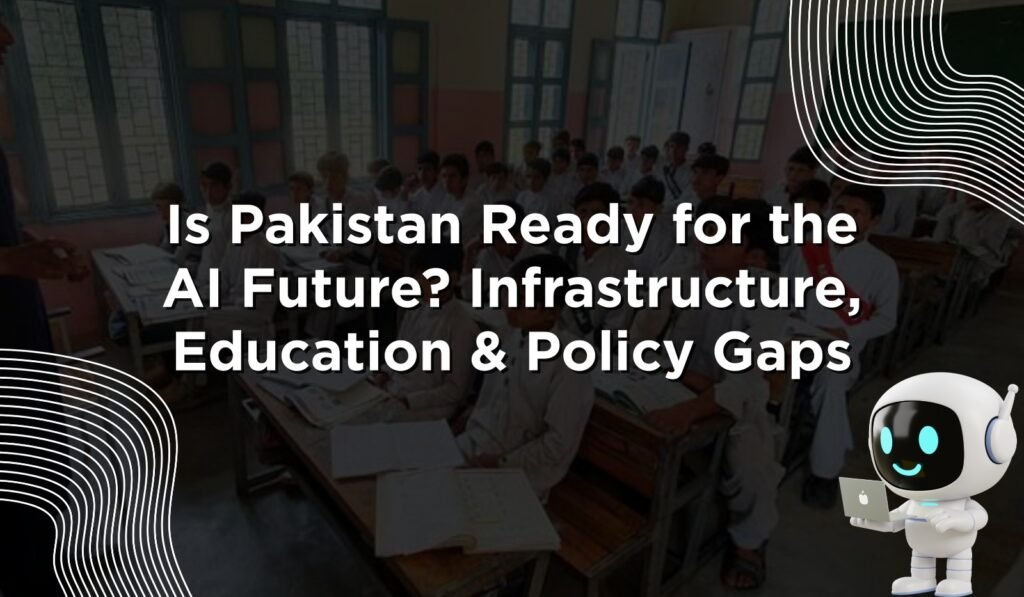
The global conversation has shifted from if Artificial Intelligence will reshape economies to how and when. For nations like Pakistan, standing at a pivotal demographic and digital crossroads, this isn’t a speculative question, it’s an urgent imperative. The promise is immense: intelligent automation for agriculture, hyper-personalized ed-tech for millions, new frontiers in tech exports, and solutions to chronic civic problems. Yet, between this promise and reality lies a landscape of significant gaps.
A candid analysis reveals that Pakistan’s readiness for an AI-driven future is a story of vibrant, bottom-up potential straining against systemic, top-down constraints. The talent and ambition exist in abundance, but the foundational ecosystem to harness them at a national scale remains worryingly underdeveloped.
The Infrastructure Gap: The Digital Foundation is Cracking
AI doesn’t run on ideas alone; it runs on data, connectivity, and processing power. Here, Pakistan faces a critical deficit.
- The Data Drought & Connectivity Chasm: AI models are built on vast, clean, and accessible datasets. Pakistan suffers from a severe lack of organized, public, and machine-readable data across sectors, from healthcare records to agricultural yields. Furthermore, while urban centers enjoy improving 4G, the digital divide remains stark. Reliable, high-speed internet, the very oxygen of an AI economy, is a luxury for a large portion of the population. Training and deploying AI at scale requires ubiquitous bandwidth we simply do not yet have.
- Compute Power: An Imported Luxury: The lifeblood of AI development is computational power—GPUs and specialized chips. Pakistan possesses virtually no indigenous capacity for producing or hosting high-performance computing infrastructure. Access to cloud-based AI services, while available, is hampered by costly dollar-denominated subscriptions and intermittent foreign exchange constraints. For startups and researchers, this makes experimentation and scaling prohibitively expensive.
The Education Gap: A Syllabus from a Bygone Era
The nation’s single greatest asset is its youth. Yet, our academic institutions are, with few exceptions, failing to equip them for the AI century.
- Theoretical Lag, Practical Void: Most computer science curricula in public and private universities are years behind the innovation curve. Courses on fundamental machine learning and data science are often optional, not core. The teaching remains intensely theoretical, with little exposure to the tools, TensorFlow, PyTorch, cloud AI platforms, that the global industry uses. Students graduate with degrees in computing but without the practical skills to build an intelligent application.
- The Interdisciplinary Missing Link: AI’s true power is applied to healthcare, climate, finance, and logistics. This requires interdisciplinary minds. Our education system operates in rigid silos. A medical student rarely learns about diagnostic algorithms; an agriculture student isn’t taught about satellite image analysis for crop health. This lack of fusion between domain expertise and AI literacy is a major innovation blocker.
- Brain Drain vs. Brain Gain: The most talented graduates who manage to self-educate and build these skills often find a local market that cannot absorb or value them appropriately. The path of least resistance leads abroad, perpetuating a crippling brain drain. The challenge is not just creating talent, but creating an ecosystem that retains and rewards it.
The Policy & Ecosystem Gap: Navigating Without a Compass
Perhaps the most profound gap is not in wires or classrooms, but in vision and coordination.
- The Strategy Void: While many nations have published detailed, funded national AI strategies, Pakistan’s approach remains fragmented and nascent. Without a clear, centralized strategy, efforts by different ministries, regulators, and provincial governments risk being disjointed or contradictory. Key questions around technology governance, AI ethics, and public-private data partnerships remain unanswered.
- Funding the Leap: Building AI readiness requires massive, strategic investment in digital infrastructure, research grants, and public dataset creation. Current levels of public and private venture capital allocated specifically to deep-tech and AI startups are a drop in the ocean compared to the need. The risk-averse banking sector is ill-equipped to fund such speculative, high-potential ventures.
- Regulation in the Dark: The regulatory environment for emerging technologies is either absent or modeled on outdated frameworks. Ambiguity around data privacy, algorithmic accountability, and digital sovereignty creates uncertainty for entrepreneurs and investors. A forward-looking, innovation-friendly regulatory sandbox is desperately needed to allow solutions to be tested safely.
The Path Forward: Bridging the Chasm
This analysis is not a condemnation but a call for structured, urgent action. The gaps are wide, but not unbridgeable. The journey requires:
- A National AI Framework: A living document, crafted with input from industry, academia, and civil society, that sets clear priorities, standards, and investment plans. This is the essential first step.
- Public-Private Digital Moonshots: The government must partner with tech firms to launch flagship projects, a national agriculture AI platform, a unified health data analytics dashboard, that solve public problems while building infrastructure and talent pools.
- Curriculum Revolution & Alternative Pathways: Universities must urgently overhaul syllabi. In parallel, a nationwide push for accredited online certifications, bootcamps, and industry apprenticeships can create faster, more agile pipelines for AI talent development.
- Incentivizing Retention & Investment: Tax holidays for AI-focused startups, grants for local computer infrastructure, and easier forex mechanisms for SaaS companies can stimulate the local ecosystem and make “stay and build” the most attractive option for talent.
Conclusion: A Race Against Time
Pakistan is not ready for the AI future, but no emerging economy fully is. Readiness is not a static state to achieve, but a relentless process of adaptation. The vibrant hustle of the freelance developer, the student building a chatbot in her hostel room, the entrepreneur trying to automate a small factory, these are the members of Pakistan’s AI potential.
The question is whether the state and private sector can build the hearth around them: providing the fuel of data, the oxygen of connectivity, and the structure of supportive policy. Without a concerted, systemic effort to address these foundational gaps, the risk is not merely falling behind. The risk is that the brilliant minds who could build Pakistan’s AI future will simply build it for someone else’s.
The clock on the AI revolution ticks for everyone. Pakistan must decide if it will be a spectator or an architect. The gaps are clear. The blueprint for action exists. The will to execute is now the only variable that matters.