
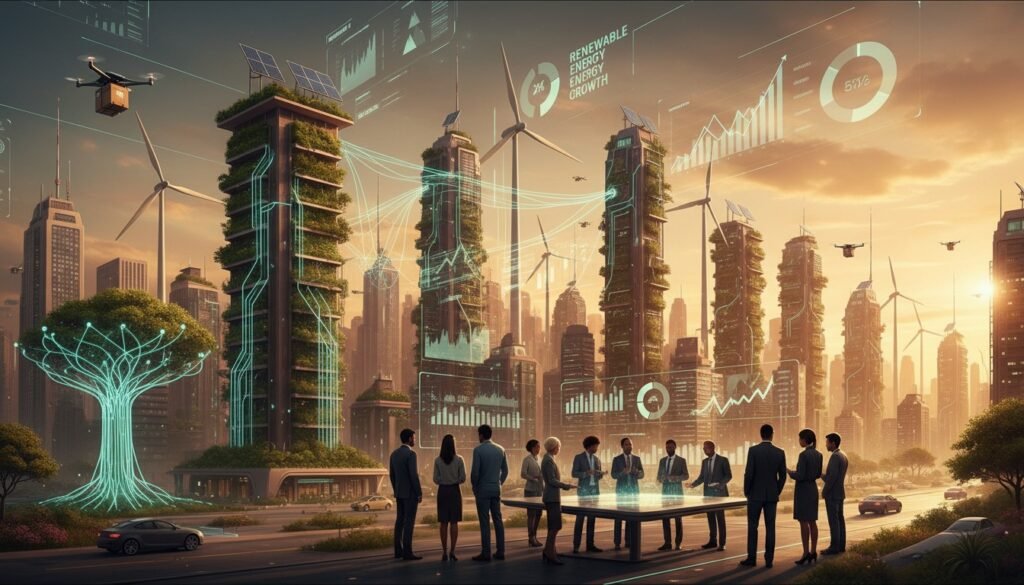
For years, Pakistan’s startup ecosystem has been synonymous with fintech, e-commerce, and logistics. Giants like Airlift (before its downfall) and various retail aggregators dominated headlines and attracted the lion’s share of venture capital. However, a significant pivot is underway. As the country grapples with the devastating realities of being one of the most climate-vulnerable nations on Earth, a new breed of entrepreneur is emerging, one focused on survival, sustainability, and green innovation.
Climate Tech Startups are quietly building a movement, and the early signs indicate that this sector could dwarf all others in terms of long-term impact and investment potential. With the government now actively courting green investment and international development banks funneling money into the space, Pakistan stands on the cusp of a green revolution powered by its youth .
The Perfect Storm: Vulnerability Meets Opportunity
To understand why climate tech investment is poised to explode, one must first grasp the scale of the problem. Pakistan is consistently ranked among the top ten countries most affected by climate change. The 2022 floods, which submerged a third of the country, were a brutal wake-up call, causing billions of dollars in damage.
Addressing this crisis requires capital, massive amounts of it. Prime Minister Shehbaz Sharif recently highlighted on the global stage at the World Governments Summit in Dubai that Pakistan’s energy transition alone demands an investment of approximately $100 billion . This staggering figure represents not just a government expenditure line, but a massive market opportunity for private players.
The Prime Minister has explicitly invited private investors to explore Pakistan’s clean energy and infrastructure opportunities, emphasizing that multilateral institutions must support emerging economies like Pakistan in achieving sustainable growth . For venture capitalists and angel investors, this high-level political commitment signals that the door is wide open for green startup funding.
Government Engines: The Climate Finance Accelerator
The most significant recent development in this space is the launch of the Climate Finance Accelerator (CFA) in Islamabad. Funded by the UK government and implemented by DAI, this initiative is designed to bridge the gap between promising climate projects and serious investors .
Federal Minister for Climate Change, Dr. Musadik Malik, has been unequivocal about the government’s new direction. At the CFA launch, he framed climate action as an economic necessity driven by youth. “We are a developing economy, and there is an urgent need to empower our youth. If we provide access and opportunities to young people, they can bring about a revolution for this country and for our economy,” he stated .
The CFA isn’t just a talking shop; it has tangible results. Since its inception in 2022, it has already supported 22 projects across sectors like renewable energy, transport, waste management, and agriculture, mobilizing nearly US$40 million in investment . The program is now open for its next call, specifically looking for businesses with a minimum investment requirement of US$4 million, offering pro bono support on financial structuring and investment readiness .
This is a clear signal that the ecosystem is maturing. We are moving beyond ideation to bankable, scalable sustainability-driven startups.
Success Stories Proving the Concept
While policy is crucial, the real excitement in the venture community comes from proof of concept. Pakistan is already producing climate innovation Pakistan can be proud of, with startups gaining international recognition.
Modulus Tech, founded by Mohammed Saquib, is a prime example. This startup produces energy-efficient, low-cost modular flat-pack housing built from recycled materials. With Pakistan facing a housing shortage of up to 10 million units, the market is enormous. Modulus Tech’s houses are not only affordable and assemblable in three hours, but they also boast a carbon footprint up to 52 times lower than traditional concrete homes and are three times more energy efficient . This is a triple win: social impact, environmental sustainability, and market viability. Saquib’s work earned him a UN Environment grant, validating the global appeal of such low-carbon technology .
Another standout is TrashIt, founded by Anusha Fatima. In a landmark move for the ecosystem, TrashIt recently won the first-ever Sustainability Award at the Visa and HBL She’s Next 2026 program, receiving a $10,000 grant . TrashIt is tackling Pakistan’s massive waste management problem by converting waste into valuable resources. This recognition from a major corporate entity like Visa shows that the private sector is actively scouting for carbon reduction startups that blend profitability with purpose .
Furthermore, the National Incubation Center (NIC) Islamabad is actively betting on this trend. As it issues its final call for Cohort 5, the NIC has explicitly listed Climate Tech alongside AI and deep tech as a high-impact sector for incubation . The fact that a government-backed incubator is prioritizing green ventures means that the infrastructure for mentorship and early-stage funding is being built right now.
The Ecosystem Gains Momentum
The growing focus on green ventures is attracting attention from major international development partners who are willing to place bets that de-risk investment for others.
The “Start-up Pakistan” initiative, launched by the Aga Khan Foundation (AKF) and Germany’s KfW Development Bank, is specifically targeting the clean tech ecosystem . Financed by the German government, this initiative aims to support startups in sectors including the “green economy,” prioritizing digitization and environmental sustainability. The project aims to create over 2,500 direct jobs and support 1,500 entrepreneurs, with a target of 50% women and youth participation .
Similarly, the Green Fields Programme by the Ministry of Climate Change is creating platforms where young innovators can pitch climate-focused ideas to national and international investors. The Ministry has already taken two Pakistani companies to Seville, Spain, to pitch on an international stage .
This confluence of grassroots innovation, incubator support, and international development finance creates a fertile ground for venture capital to step in and scale these operations.
Addressing the Early-Stage Risks
Of course, the path for Climate Tech Startups is not without its hurdles. Unlike a SaaS product that can be built in a garage, many climate solutions are hardware-heavy or infrastructure-dependent. They often require longer gestation periods and higher capital expenditure, which can scare off traditional VC funds looking for quick returns.
This is where the government’s new institutional mechanisms come into play. Dr. Musadik Malik has stated that dedicated centers are being established to prepare international-standard climate projects, enabling Pakistan to access global climate finance more effectively . By de-risking the early stages through grants and technical assistance (like that provided by the CFA), the government is essentially preparing a pipeline of investment-ready startups for later-stage VCs.
Furthermore, policy reforms are accelerating adoption. The government is rapidly scaling up solar, wind, and hydropower, backed by tax exemptions, net metering, and waivers on customs duties for solar equipment . This creates a favorable market dynamic for startups operating in the renewable energy space, as the cost of adoption for consumers drops.
The Macro View: A $100 Billion Addressable Market
Ultimately, the investment thesis for climate tech in Pakistan rests on the sheer size of the addressable market. The Prime Minister has clearly outlined the targets: achieving a 60% clean energy mix by 2030 and transitioning 30% of all vehicles to electric mobility .
To put that in perspective, Pakistan’s southern regions hold an untapped wind energy potential of 50,000 megawatts, and northern hydropower projects will add another 13,000 megawatts of clean energy capacity .
Whether it is EV infrastructure (like Aiman Shafique’s EV Square, another She’s Next winner) , solar financing, battery storage, or grid management software, the opportunities are vast. The country is essentially announcing to the world that it needs to rebuild a significant portion of its energy and transport infrastructure, and it wants the private sector to lead the way.
Conclusion
For too long, the narrative around Pakistan has been one of vulnerability to climate change. While that remains a tragic reality, a new narrative is being written, one of resilience, innovation, and opportunity. Climate Tech Startups are emerging as a beacon of hope, combining the country’s massive youth bulge with the urgent need for sustainability.
With the government actively streamlining investment through the SIFC , with international accelerators like the CFA pumping in expertise and capital , and with local success stories gaining global recognition , all the ingredients are in place.
For investors who missed the early wave of Pakistani fintech, or who are wary of the saturation in e-commerce, the message is clear: climate tech is not just a feel-good investment. It is the next major investment opportunity in Pakistan, driven by necessity and backed by the full weight of the state and international community. The startups are ready. The policy is ready. The only question left is: are the investors ready to seize the moment?