
The narrative is seductive in its simplicity. Artificial intelligence, we are told, is the great equalizer. It will democratize access to information, create high-value jobs for Pakistan’s youth bulge, and catapult the nation into a prosperous digital future. The government’s approval of the National AI Policy 2025, with its ambitious goal of training one million individuals in AI by 2030, is presented as the definitive roadmap to this promised land .
But beneath the glossy policy documents and the celebratory press releases, a more troubling reality is taking shape. Far from bridging the skills gap, the AI revolution in Pakistan is poised to become a powerful engine of Income Inequality, concentrating wealth and opportunity among the urban elite while leaving the vast majority of the population further behind. The hard questions are being ignored: Who among us will be excluded? Who will benefit? Will algorithms reproduce existing class and gender hierarchies? .
The Architecture of Exclusion
To understand how AI will deepen Economic disparity, one must first confront the brutal arithmetic of Pakistan’s digital divide. According to a comprehensive report by the Asian Development Bank (ADB), Pakistan’s digital sector contributes a meager 1.5% to the country’s GDP, a figure significantly lower than regional counterparts . Fixed broadband access is limited to just 1.3% of the population, and the fiber optic network remains extremely underdeveloped .
While 80% of Pakistan’s population has access to mobile internet, its effective usage remains abysmally low . The barriers are not technical; they are structural. The rising cost of digital devices, coupled with the limited availability of internet services, has created a Tech accessibility gap that splits the nation into two distinct realities. In one reality, urban centers like Islamabad, Lahore, and Karachi, AI startups flourish, freelancers earn dollars, and young professionals discuss the latest large language models . In the other reality, rural Sindh, Balochistan, and Khyber Pakhtunkhwa, millions remain digitally silent, their voices and needs invisible to the algorithms being trained on urban datasets.
The gender dimensions of this divide are particularly stark. The ADB reports that while 86% of men own mobile phones, only 53% of women do. The internet usage gap is even wider: only 33% of women use the internet compared to 53% of men . In rural areas, the situation is catastrophic, with just 14% of women having access to smartphones or the internet . How can AI bridge a skills gap when half the population cannot even access the tools required to participate in the digital economy?
The 60% Vulnerability
The threat posed by AI is not limited to those already excluded; it extends to millions who are currently employed but whose jobs are most susceptible to automation. An estimated 60% of Pakistan’s workforce is vulnerable to automation in routine tasks . This is not a distant, futuristic concern. Robotic process automation is already being experimented with in Pakistan’s banking and telecom sectors. E-commerce giants have begun exploring AI-based warehouse management and delivery logistics .
Consider the implications for Pakistan’s employment structure. Over 64% of the population is under the age of 30, and the informal sector constitutes more than 70% of total employment . What happens to the daily wager, the warehouse loader, the call center representative, when AI steps in? As one financial expert warns, “the same technology can entrench inequality and stagnation or unleash growth and inclusion. The difference lies in policy choices” .
Currently, those policy choices are not inspiring confidence. The National AI Policy’s focus on training one million professionals is commendable on paper, but it ignores the foundational crisis of digital illiteracy. According to the Pakistan Bureau of Statistics, over 22.8 million children are out of school. The curriculum emphasizes rote learning over critical thinking, and less than 10% of public schools have functional computer labs . The policy speaks of including AI in public school curricula, but as digital rights experts point out, “thousands of schools across the country are devoid of functional computer labs. How then can AI be taught to students who do not even have access to computers?” .
The Hourglass Economy
The trajectory Pakistan is on leads toward what economists call an “hourglass economy”, a fat top of elites, a fat bottom of the poor, and a thin, vanishing middle . The middle class, the clerks, accountants, and mid-level managers, are precisely the segments most vulnerable to AI displacement. As they are pushed into low-wage service jobs, the Social mobility crisis will intensify.
Meanwhile, at the top, the benefits of AI accrue to a narrow slice of society. Multinational corporations operating in Pakistan, banks, telcos, logistics companies, are rapidly integrating AI into their systems. Chatbots handle customer complaints, fraud detection models analyze transactions, and delivery algorithms optimize logistics. Yet this AI wave rarely translates into employee training or job creation. Often, it leads to leaner operations and fewer human roles. The profits grow, but do the people? .
The Pakistan Software Houses Association (P@SHA) has warned that these gaps in inclusion could limit the industry’s long-term competitiveness. In a white paper released in January 2026, P@SHA argued that inclusion is now a “core economic requirement rather than a social add-on.” The tech sector cannot sustain its global ambitions if “large segments of potential talent remain excluded” . Yet the current trajectory suggests exactly such exclusion.
The Urban vs. Rural Divide
Perhaps the most visible manifestation of AI-driven Income Inequality is the Urban vs rural income gap. Punjab leads in digital experimentation, from AI-enabled surveillance in Lahore to agricultural pilots in Faisalabad. In contrast, Balochistan and Gilgit-Baltistan have no state-backed AI programs, and even Khyber Pakhtunkhwa, despite its tech-savvy youth, lacks AI-specific funding mechanisms . This uneven development reinforces provincial resentments, as digital progress becomes another lens of inequality.
Even within agriculture, the backbone of rural Pakistan, the benefits of AI are likely to be concentrated. While AI-powered precision farming promises to increase yields and reduce water usage, these technologies require investment, technical knowledge, and infrastructure that small landholders cannot afford . The result will be a consolidation of agricultural productivity in the hands of large, capital-intensive farms, further marginalizing subsistence farmers.
The linguistic barrier compounds this divide. With over 70% of Pakistan’s population speaking languages other than English, and with Urdu natural language processing tools still underdeveloped, AI applications built on Western datasets fail to serve the majority . Voice assistants, chatbots, and recommendation engines remain largely English-centric. Efforts like the Lughat project or Urdu corpus development remain academic and disconnected from mainstream tech products. This exclusion marginalizes non-English-speaking communities, creating a class of “digital outcasts” .
The Data Colonialism Trap
AI runs on data, and Pakistan lacks a coherent national data protection law. The Personal Data Protection Bill has remained stuck in bureaucratic review since 2021 . With global AI ethics emphasizing data privacy, algorithmic transparency, and human rights, Pakistan risks becoming a “data colony”, feeding global AI systems without safeguarding its own citizens.
This is not an abstract concern. Facial recognition systems are being deployed in major Pakistani cities without proper public consultation. The risk of profiling, political targeting, and social control via AI tools cannot be ignored in a country with an already fragile civil liberties record . The Digital Rights Foundation has raised “serious questions around transparency, ethical safeguards and protecting marginalised communities from discrimination” . Without stringent oversight, AI can become a tool of repression rather than empowerment, deepening existing power asymmetries.
The surveillance dimensions are particularly alarming. The AI policy includes plans for E-khidmat centres for public services, health, education, sanitation, energy, security and other government services through AI chatbots and centralized service delivery. This raises surveillance risks, especially in the absence of a data protection regime . Furthermore, overreliance on AI when people need assistance and interface with government officials will only mirror current portals and helplines where people never hear back.
The Fork in the Road
Pakistan stands at what experts describe as a “fork in the road” for AI development . One path leads to the hourglass economy, elite concentration, middle-class hollowing, and rural exclusion. The other path leads to inclusive growth, where AI tools empower less-skilled workers to perform like seasoned professionals, where a junior coder in Lahore, supported by an AI assistant, produces work comparable to a senior engineer, and where call center workers double their productivity with AI assistance .
The deciding factor is not technology itself, but policy design and institutional reform. The P@SHA white paper offers a clear implementation roadmap, recommending measures such as a voluntary Diversity Pledge for organizations and targeted policy interventions to improve leadership representation and inclusive workplace environments . The ADB recommends expanding fiber-optic cables, especially in backward and rural areas, and increasing demand for high-speed internet in schools and hospitals .
Yet current policy responses remain inadequate. The National AI Policy was formulated without an inclusive, multi-stakeholder dialogue. Cross-cutting segments of society—including environmentalists, civil society, digital rights experts, media, and the healthcare and education sectors, were largely excluded from the process . There has been no parliamentary debate, no transparent stakeholder engagement. The policy speaks of AI for the environment but ignores the climate-related risks of AI data centers in a water-scarce country where over 80% of the population faces water scarcity .
What Inclusion Would Require
Reversing the trajectory toward greater Income Inequality requires a fundamental reorientation of priorities. Every rupee from the AI Innovation Fund and every watt of power for the national computer grid must be prioritized for bridging the digital divide . This means:
First, infrastructure first. Without last-mile connectivity, all talk of AI literacy is meaningless. The fiber optic network must be expanded urgently to rural and underserved areas .
Second, affordability. The ADB has highlighted the high taxation burden on Pakistan’s telecom sector, the highest in the region. The government must create a more investment-friendly environment to attract capital and make devices and internet access affordable for low-income groups .
Third, targeted inclusion. Special training programmes for women and persons with disabilities are mentioned in the policy, but they must be scaled dramatically . The ADB recommends training women and young people in rural areas in online business to support internet use and economic inclusion .
Fourth, linguistic inclusion. Pakistan must invest in developing machine-learning models in Urdu, Sindhi, Punjabi, Pashto, Seraiki, and Balochi so that AI tools are available to speakers of these languages . Reliance on foreign languages must be reduced.
Fifth, data protection. The Personal Data Protection Bill must be passed without delay and monitored by an independent digital ombudsman . A citizen data trust should be created to ensure the people, not private firms, control the use of national data resources.
Sixth, ethical governance. All government tenders involving AI tools must be subjected to pre-deployment risk assessments to avoid unintended harms. Judicial and law enforcement tools using AI must be subjected to algorithmic audits to prevent bias and abuse .
Conclusion: Who Will AI Serve?
The question is not whether AI will come to Pakistan. It already has. Chatbots handle customer complaints, algorithms assess credit worthiness, and facial recognition systems scan public spaces. The real question is: who will it serve? .
The evidence suggests that without urgent, deliberate intervention, AI will serve the few, not the many. It will deepen Income Inequality by concentrating opportunities among the urban, educated, English-speaking elite while marginalizing the rural, the poor, and the non-English-speaking majority. It will widen the Urban vs rural income gap and entrench existing gender hierarchies .
As Dr. Tariq Rahim argues, “We value knowledge less for what it explains than for what it earns.” This narrow calculus has pushed the social sciences, the very disciplines that help us interpret who we are and how we coexist, to the margins. “A society capable of building systems but unable to assess their consequences is not advanced; it is vulnerable” .
Pakistan has the intellectual roadmap to transform its socio-economic landscape using AI. The National AI Policy provides the blueprint. But as the ADB warns, the “chasm between policy aspiration and practical implementation remains vast” . To ensure this future is truly national and inclusive, the focus must shift fiercely to equity.
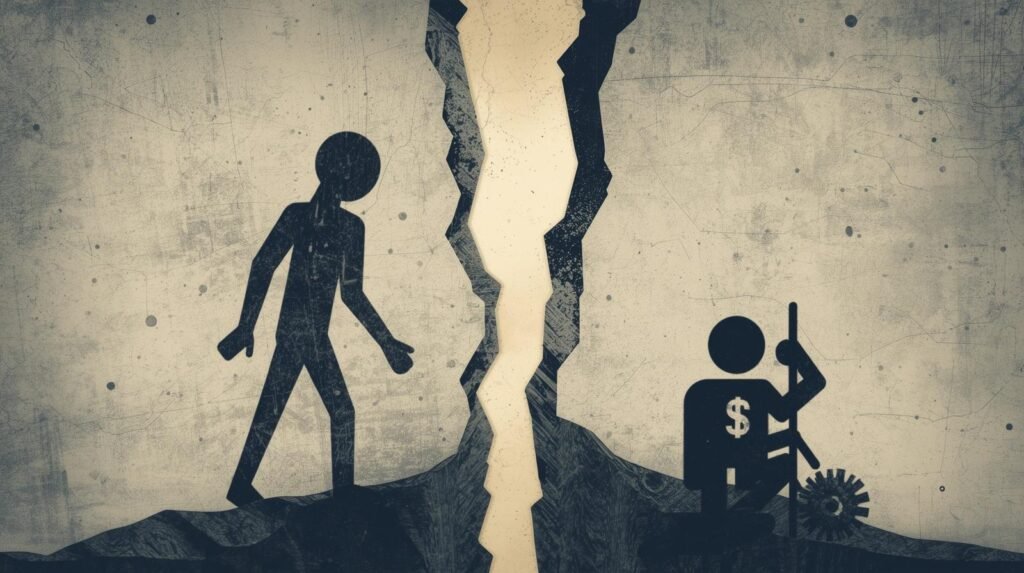
The alternative is a Pakistan where AI becomes not a tool for collective prosperity, but a luxury for the privileged few, deepening the already wide chasm between those who have and those who have not. The time for cautious planning is over. The time for equitable, ethical, and aggressive execution is now.