

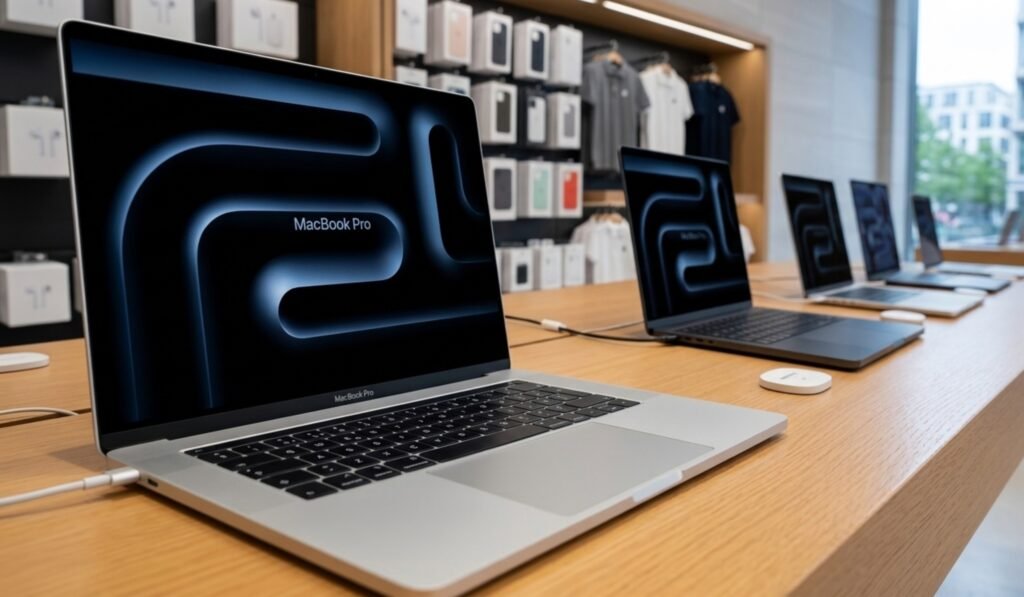
Apple may finally be getting ready to change the MacBook Pro in a bigger way. Not just faster chips. An actual redesign. According to Bloomberg, the company is working on new MacBook Pro models planned for late 2026. The update could bring thinner hardware, OLED displays, and something Apple has avoided for years. A touchscreen. That last part stands out most.
Apple has spent nearly two decades pushing back against touchscreen Macs. The company always treated the iPad and Mac as separate products with different ways of interacting. Touch belonged to one. The keyboard and trackpad belonged to the other. Now that line may be starting to blur. Reports say Apple is testing touchscreen support as part of the next MacBook Pro overhaul. If it happens, it would be one of the biggest shifts the product has seen in years. The redesign would also introduce OLED screens to the MacBook Pro lineup. Apple already moved in that direction with the iPad Pro in 2024, when it launched Tandem OLED displays. The difference was noticeable. Better contrast. Deeper blacks. Stronger brightness levels. MacBooks still use miniLED panels today. OLED would change the look of the display quite a bit, especially for creators and video professionals. The delay appears tied to manufacturing problems. Industry reports say Apple originally wanted the redesign earlier, but OLED production timelines slowed things down.
Samsung Display is expected to play a major role here. Its OLED production lines need to be ready before Apple can move forward at scale. Inside the laptop, Apple is preparing newer chips too. The redesigned models are expected to use M6 Pro and M6 Max processors built on TSMC’s 2nm process. That matters because smaller manufacturing processes usually improve efficiency and performance together. Less power use. More speed. There is another feature being discussed quietly as well. Cellular connectivity. MacBooks have never offered direct mobile network support before. Apple reportedly wants to change that eventually, using its own modem technology. That would let future Macs connect without relying fully on Wi-Fi. The hardware itself is also expected to get thinner. But not radically thin.
Apple seems careful this time. The company has already learned what happens when design becomes too aggressive. Back in the 2016 to 2020 period, MacBook Pros became extremely thin. That led to overheating complaints, keyboard failures, and criticism over missing ports. This redesign sounds more controlled. Slimmer, but not at the cost of usability. Pricing could still become an issue, though. OLED displays cost more to produce. Advanced chip manufacturing is expensive, too. Analysts think the next MacBook Pro models may end up costing noticeably more than current versions. Before all of this arrives, Apple is still expected to release MacBook Pro updates using M5 chips first. Those machines will probably look mostly the same as today’s models.
The bigger redesign comes later. Right now, late 2026 is the expected target. But production delays could easily push parts of the launch into 2027. Apple has not officially confirmed any of the reported changes yet. Still, the direction is becoming clearer. After years of keeping the MacBook mostly unchanged, Apple may finally be preparing a much larger reset.