

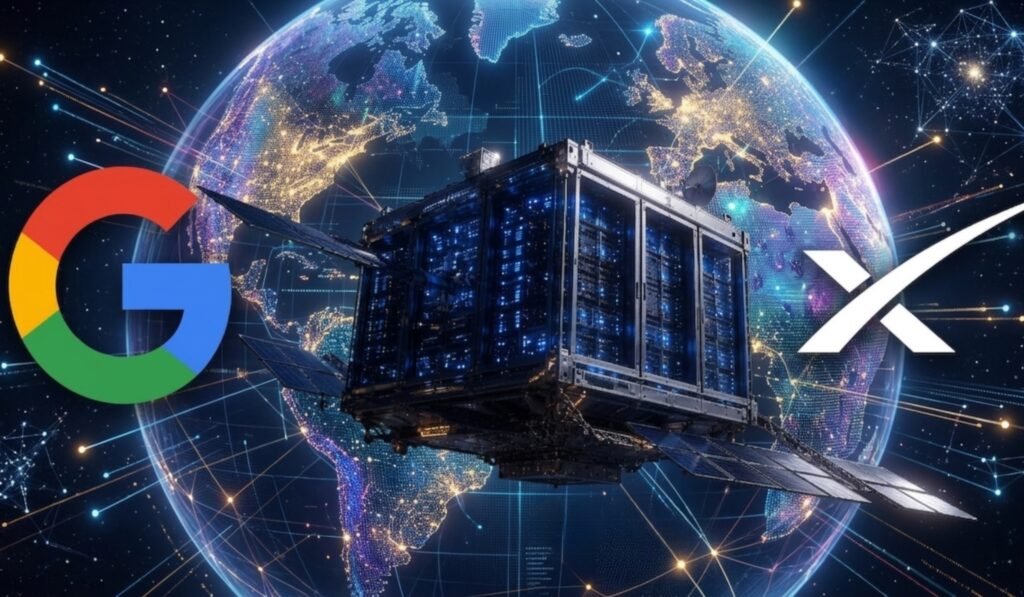
Google and SpaceX are talking about something unusual. Data centers in space. Not confirmed yet, just early discussions according to Wall Street Journal reporting. spaceXThe idea sounds simple at first. Move computing hardware off Earth. Run AI workloads in orbit. But the reality is messy. Launch costs alone sit around $7,000 per kilogram. That number alone slows everything down.
Google already has a direction in mind. It is working on something called Project Suncatcher. The plan appeared in November 2025. The goal is prototype satellites by 2027. These satellites would not just carry sensors. They would carry Tensor Processing Units. Basically Google’s own AI chips, placed in orbit. The design leans on solar power. Continuous energy from the sun. No night cycles like Earth. In theory, that sounds efficient. In practice, it still needs testing. Google has also been speaking with other space companies. Planet Labs is one of them. The focus is satellite design and how to actually build these systems at scale.
SpaceX has a different angle. It sees orbital computing as a long-term infrastructure shift. Elon Musk has said space could eventually be cheaper than Earth for heavy compute workloads. His argument is not only about energy. It is also about logistics. No land restrictions. No local opposition. No zoning fights over massive data center campuses.
Sundar Pichai has also commented in a broader way. He believes space-based data centers could become normal within a decade. He did not frame it as immediate. More like direction than timeline. There is also a bigger industry backdrop here. Demand for AI compute is rising fast. Every major company is scaling infrastructure at the same time.
Some analysts estimate Google’s plan only works if launch costs drop sharply. One figure puts it near $200 per kilogram for the model to make sense. That is far from today’s reality. Even if costs improve, engineering problems remain. Radiation is a major one. Chips do not behave well in space conditions. Errors can appear in calculations. That is a serious issue for AI workloads. Then there is heat. On Earth, cooling systems handle it. Fans, water loops, massive infrastructure. In space, heat has nowhere simple to go. That changes the entire design problem.
There is also growing pressure on Earth-based systems. Global data center electricity use is expected to cross 1,000 terawatt-hours by 2026. That is roughly equal to Japan’s yearly consumption. That scale is why companies are even thinking about alternatives. Still, not everyone is convinced. Some experts call the idea premature. OpenAI CEO Sam Altman has previously dismissed similar concepts as unrealistic for now. Others point out the gap between vision and execution. Rockets, cost, maintenance, reliability. Everything becomes harder once hardware leaves Earth. But the discussion is no longer theoretical. It is now inside actual corporate planning conversations. Google is testing the idea through satellites. SpaceX is exploring infrastructure support. And both are circling the same question from different angles.
Can AI computation move beyond Earth at all? No clear answer yet. Just early steps, rough math, and a lot of engineering problems still waiting to be solved.