
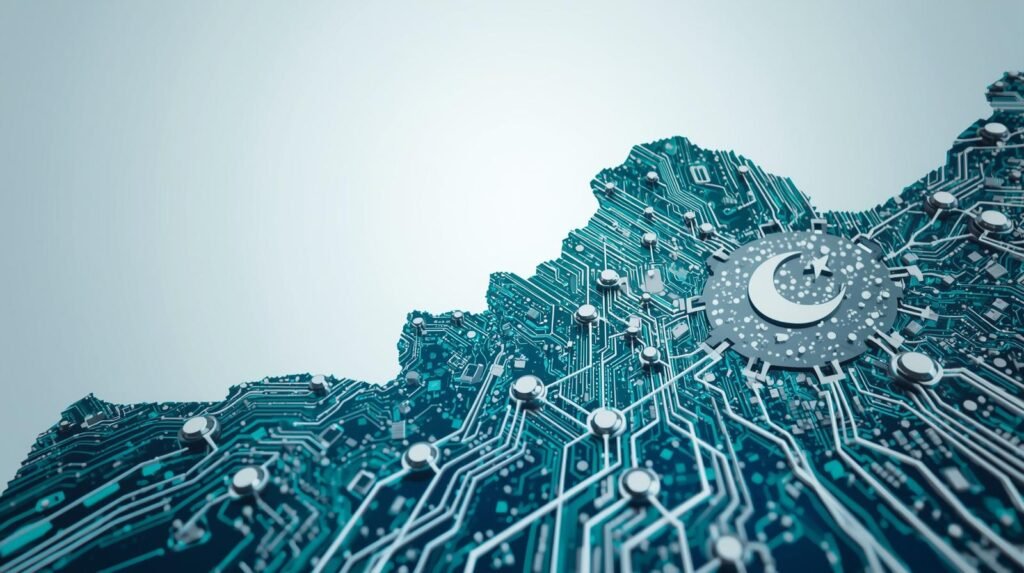
The headlines are undeniably impressive. Pakistani freelancers have pocketed a record-breaking $557 million in just six months. IT exports are surging at nearly 20% growth. The combined value of the country’s venture capital-backed startups has crossed the $4 billion mark, outperforming regional hubs like India and Dubai . On paper, Pakistan’s Digital Economy is on a rocket ship trajectory. However, a deeper dive into the data reveals a troubling paradox: while the quantity of digital activity is booming, the quality, specifically, high-value innovation, is lagging dangerously behind. We are exporting more hours and services than ever before, but we are not yet exporting the intellectual property, proprietary platforms, and deep-tech solutions that define true economic transformation.
The Numbers Game: A Story of Volume
There is no denying the sheer scale of growth. The ICT sector has emerged as Pakistan’s star performer, with export remittances hitting $2.61 billion in the first seven months of FY2025-26, a 19.78% increase from the previous year . January 2026 alone saw exports of $374 million, underscoring the sustained global demand for Pakistani tech labor . This growth is fueled by a massive freelancing workforce, estimated at around 2.37 million strong, placing Pakistan among the top global freelancing markets .
This boom in the freelancing economy is a critical source of foreign exchange, particularly vital for a country navigating balance-of-payments challenges. Services like software development, digital marketing, and graphic design are being exported at scale . Simultaneously, the e-commerce market Pakistan is projected to reach $7.5 billion by 2026, with new players like Goldbox entering the fray to build trust in online transactions . The fintech revolution is also gaining steam, with the number of individuals using digital banking surpassing 127 million, fueled by the state-backed Raast payment system which processed a staggering Rs 1.6 trillion in government payments between July 2025 and January 2026 .
On the surface, these metrics paint a picture of a sector firing on all cylinders. The government celebrates these achievements, and rightfully so, as they signal growing global confidence facilitated by bodies like the Special Investment Facilitation Council (SIFC) . Digital transformation in Pakistan is visible in the rising digital payment adoption rates and the expansion of mobile broadband, which now reaches 151 million subscribers .
The Innovation Deficit: Volume Over Value
Yet, the celebratory tone masks a structural weakness. Pakistan’s Digital Economy is thriving on the export of “human hours” rather than “high-value products.” The bulk of IT exports consist of freelancing and IT-enabled services (ITES), outsourced tasks that, while lucrative, sit at the lower end of the global value chain. We are code writers, not code owners; we are the back-end support, not the platform creators.
The fintech revolution, for instance, has seen $52.5 million in funding, but much of this is concentrated in payments and lending, with less emphasis on deep-tech innovations like blockchain infrastructure, AI-driven financial modeling, or RegTech solutions that could be exported regionally . The upcoming Pakistan FinTech Summit, launched in partnership with Dubai, is a fantastic opportunity to attract investment, but the risk is that it will primarily showcase Pakistan as a massive consumer market for fintech rather than a creator of globally competitive fintech products .
This pattern is repeated across the board. The e-commerce market Pakistan is growing, but it remains heavily reliant on discounts and subsidies, with platforms struggling to move beyond a “cash on delivery” mindset towards higher-value, data-driven personalization and cross-border trade . New entrants like Goldbox are trying to pivot towards sustainable profit ecosystems with consignment models, but these are incremental improvements, not foundational innovations that redefine the market . The core issue remains: we are digitizing existing commerce, not inventing new forms of it.
The Infrastructure Ceiling
The primary barrier preventing a leap from volume to value is the state of the nation’s digital backbone. Tech infrastructure challenges are not just inconveniences; they are existential threats to high-value innovation. Experts have recently warned that the government’s ambition to boost IT exports to $25 billion will remain a “pipe dream” without a resilient and high-speed internet infrastructure .
The statistics are alarming. Pakistan ranks 100th out of 111 nations for mobile internet speed and 141st out of 158 for broadband . This sluggish connectivity is a death knell for high-value sectors like AI development, high-frequency trading algorithms, or 4K/8K video production. Furthermore, the over-reliance on a few submarine cables landing in Karachi creates a single point of failure. Any disruption, natural or man-made, can effectively disconnect the nation . While the broadband penetration rate is climbing (now at 61.97%), the quality of that connection is what determines the type of economic activity it can support . Currently, the quality supports low-value, high-volume freelance work, but it fails to support the latency-sensitive, data-heavy requirements of deep tech innovation.
The Path to High-Value Innovation
Moving from quantity to quality requires a strategic pivot. The government and private sector must move beyond facilitating the freelancing economy and start building an ecosystem for intellectual property creation.
Diversify Connectivity: As proposed by experts, Pakistan must develop terrestrial fiber optic links with China and Central Asia and invest in satellite backup systems to ensure internet resilience . We must reduce our dependency on the vulnerable submarine cable system to create a stable environment for high-stakes digital businesses.
Invest in Compute Power: High-value innovation, particularly in AI and machine learning, requires massive computational resources. Currently, local researchers and startups lack access to affordable GPUs and cloud infrastructure. Public-private partnerships to establish a national cloud or subsidize computer credits for deep-tech startups are essential.
Shift from Services to Products: Policy incentives should be reoriented. While tax breaks for IT exporters are good, additional super-tax credits should be given to companies that generate intellectual property registered in Pakistan. We must encourage a shift from “body shopping” (exporting programmers) to productizing our expertise.
Strengthen the Digital Payments Ecosystem: While Raast has been a game-changer for domestic digital payment adoption, the focus must now shift to integrating Pakistani payment solutions with international gateways to facilitate high-value cross-border digital trade .
Focus on Niche High-Value Sectors: Instead of trying to compete broadly, Pakistan should identify niches where it can lead. This could be in Islamic Fintech, AI-powered agricultural solutions for arid climates, or Urdu language processing technologies. These are areas where local context provides a competitive advantage that can be transformed into a globally tradable product.
Conclusion
Pakistan’s Digital Economy is at a critical juncture. The record-breaking export figures and the surge in digital payments are proof of a solid foundation . We have the talent, the numbers, and the market size. However, the current growth model, driven by volume and low-value services, is not sustainable for long-term economic leadership.
To truly transform the economy, we must break through the infrastructure ceiling and pivot from being the world’s back office to becoming a creator of the world’s next-generation technologies. The numbers will continue to grow, but unless we tackle the tech infrastructure challenges and foster an environment where high-value intellectual property can flourish, the story of Pakistan’s Digital Economy will remain one of impressive statistics masking missed potential.