
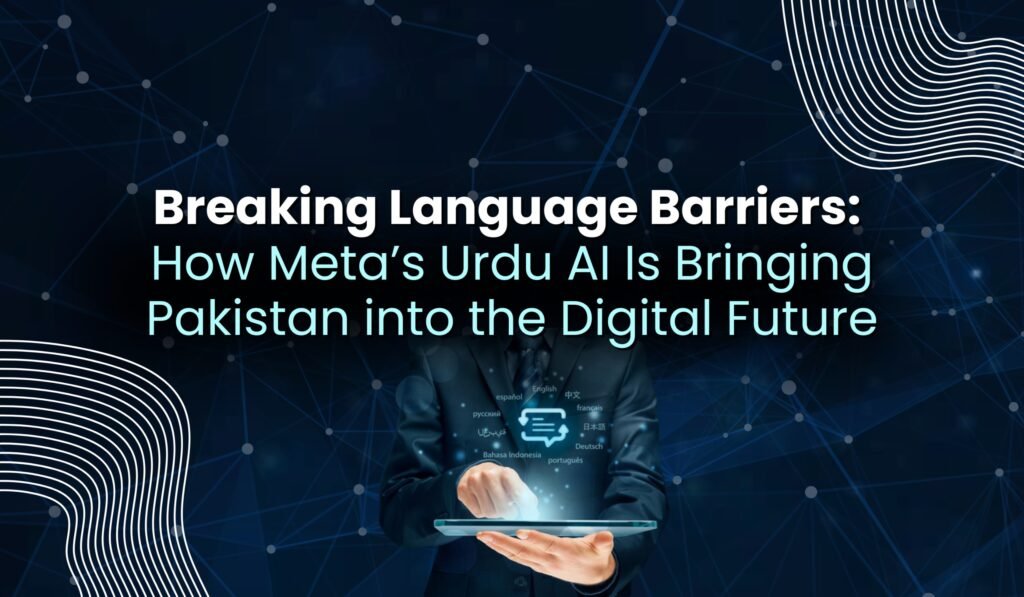
For years, the promise of Artificial Intelligence has echoed in a largely English-speaking world. But in the bustling digital streets of Pakistan, where Urdu thrives with its poetic nuance and cultural depth, that promise often hits a language barrier. That is, until now. Meta’s recent groundbreaking launch of AI tools fluent in Urdu isn’t just a product update; it’s a digital revolution for over 200 million people. It’s about finally hearing “AI” speak your mother tongue.
This move is more than translation; it’s about inclusion. By weaving Urdu into the fabric of advanced AI, Meta is effectively bridging one of the most significant gaps in global technology. Let’s explore how this leap forward is transforming AI adoption in Pakistan, enabling digital inclusion for Urdu speakers, and reshaping the everyday digital experience for millions.
The Launch: More Than Just Words
Meta’s introduction of its AI assistant and Llama models with robust Urdu capabilities marks a pivotal moment. Users on platforms like WhatsApp, Facebook, and Instagram can now interact with Meta AI in Urdu, asking complex questions, generating creative content, or seeking help, all in their native script. This isn’t a clunky, word-for-word translation tool. It’s an AI trained to understand the context, idioms, and cultural subtleties unique to Urdu.
Imagine a farmer in rural Punjab using voice notes in Urdu to ask about crop diseases and getting a localized, actionable response. Or a student in Karachi drafting a research paper by brainstorming with an AI entirely in Urdu. This is the practical power being unlocked. By prioritizing Urdu language AI tools, Meta is validating the language’s importance in the digital age and directly tackling the issue of language barriers in AI.
Why This Matters: Digital Inclusion on a Massive Scale
Digital inclusion for Urdu speakers has long been a challenge. While internet penetration grows, much of the world-class digital content and smart tools remain inaccessible to those not proficient in English. This created a two-tiered digital ecosystem: one for the English-literate and another for the rest.
Meta’s Urdu AI shatters this divide. Here’s what it means for bridging the language barrier in Pakistan:
- Democratizing Information: Access to knowledge is no longer gated by language. From health advice and legal rights to educational tutorials and market prices, information is now query-able in the most natural way for the majority.
- Empowering Small Businesses: Sellers and entrepreneurs can now use AI to craft marketing messages, manage customer service, and analyze trends in Urdu, leveling the playing field and boosting the digital economy of Pakistan.
- Preserving and Promoting Culture: AI that operates in Urdu can generate poetry, stories, and content that resonate locally. It helps digitize and promote cultural heritage, ensuring the language evolves and thrives in the modern tech sphere.
AI Adoption in Pakistan: From Novelty to Necessity
Prior to this, AI adoption in Pakistan was often limited to tech circles, large corporations, or English-speaking urban professionals. The average user might have seen Artificial Intelligence as a distant, complex concept. By embedding a friendly, Urdu-speaking AI into apps people already use daily, Meta is normalizing AI. It transforms it from a sci-fi concept into a helpful friend in your pocket.
This familiarity is key to widespread adoption. When instructions don’t require a language switch, when interactions feel natural and effortless, trust is built. We’re likely to see a surge in AI-powered services in Urdu, from education and finance to entertainment and governance, as developers now have a proven model to follow.
The Everyday Impact: A Glimpse into the Future
So, what does this look like in daily life across Pakistan?
- For Students and Educators: Personalized tutoring, explanation of complex concepts, and research assistance in Urdu can revolutionize learning outcomes, especially in public schools.
- For Content Creators: Generating ideas, drafting scripts, or creating engaging social media posts becomes infinitely easier, fueling a new wave of original Urdu digital content.
- For Families: Planning a trip, getting recipe ideas, or simply settling a debate with a quick, voiced question to AI in your living room language makes technology more intuitive and helpful.
- For the Elderly: A major demographic often left behind by tech can now use voice commands in Urdu to connect with family, access services, and navigate the digital world with dignity.
The Road Ahead: Challenges and Opportunities
The journey isn’t without its bumps. Ensuring the AI avoids biases, handles diverse Urdu dialects (from Sindhi-infused to Punjabi-accented), and maintains respect for cultural sensitivities is an ongoing task. Furthermore, digital literacy and access to smartphones remain hurdles for complete inclusivity.
However, the opportunity is monumental. Meta’s move is a clarion call to other tech giants and local innovators. It proves that bridging the language barrier in AI is not just possible but essential for true global progress. It sets a precedent for developing AI tools for other regional Pakistani languages like Pashto, Sindhi, and Balochi.
A Way Forward: Voice for Every User
Meta’s launch of Urdu language AI tools is a landmark step toward a more equitable digital world. It acknowledges that for technology to be truly global, it must be profoundly local. For Pakistan, this is a giant leap toward claiming its space in the AI revolution, not as passive consumers, but as active participants and future shapers.
It’s about ensuring that when history writes the chapter on the age of artificial intelligence, it will note that the conversation was held not just in ones and zeros, or in English alone, but also in the beautiful, flowing script of Urdu, engaging minds, empowering voices, and connecting a nation to its future, one intuitive interaction at a time. The language barrier is crumbling, and the future of AI in Pakistan is speaking a language everyone can understand.